
Made in Dieppe · Serving Greater Moncton and repair shops across Canada
Custom replacement parts for tools & equipment.
A hard-to-find plastic part holding up a repair? We help repair shops, tool dealers and equipment owners assess custom replacements. Send photos or a broken sample to discuss the design, material and manufacturing work your part needs.
The small parts that hold up a repair.
We assess plastic components for power tools, lawn and garden equipment, workshop equipment and other products. Each application needs to suit the material and manufacturing process.
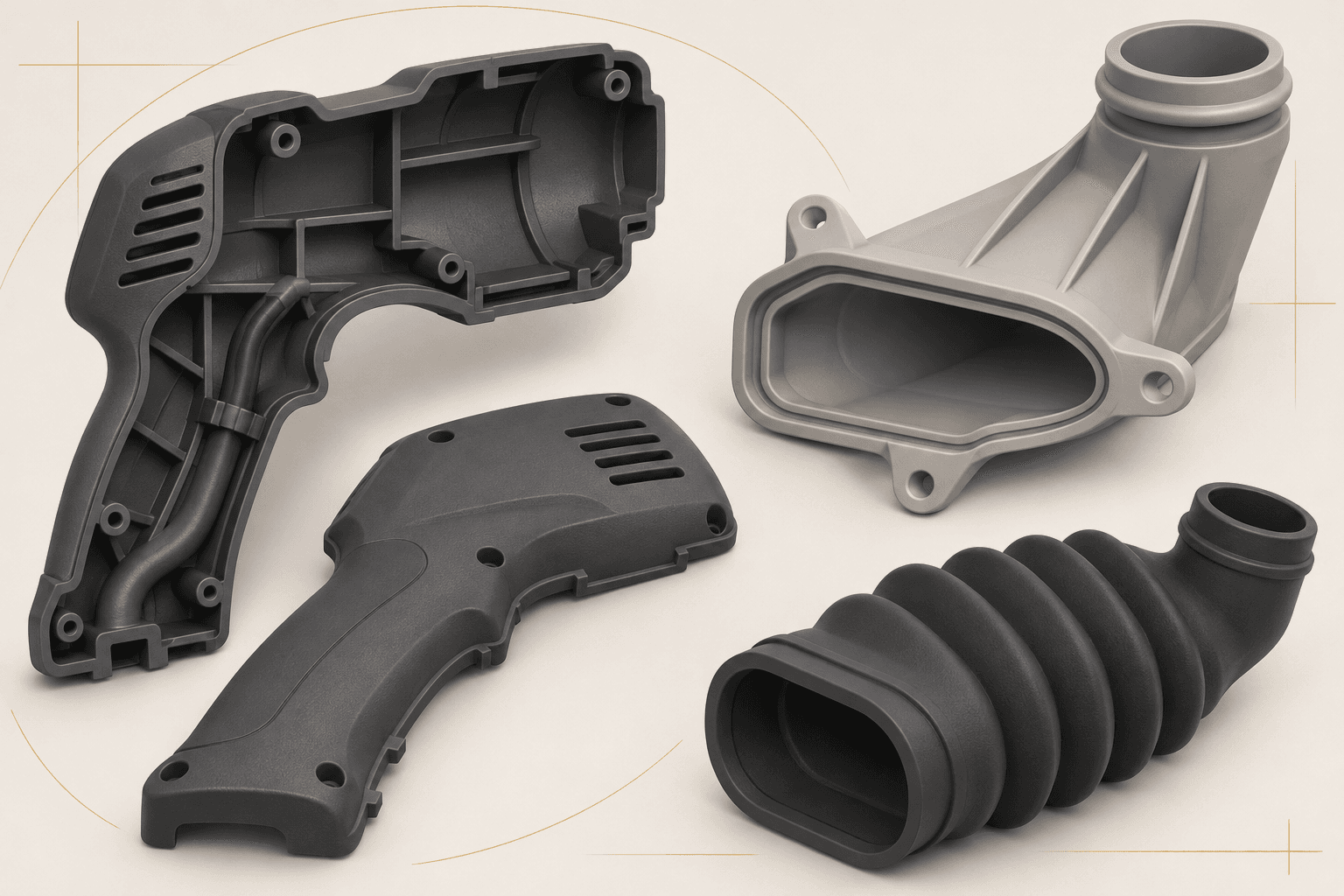
- Knobs & handles
- Grip, adjustment and controls.
- Spacers & brackets
- Positioning, mounting and alignment.
- Guides & covers
- Guidance, protection and finishing pieces.
- Housings & adapters
- Interfaces and enclosures for your equipment.
FROM THE WORKBENCH / 001
Custom chainsaw carburettor adapter
A hard-to-find part. A real workshop example.
A customer could not source the original part for an older chainsaw. We recreated the adapter geometry for their repair project.
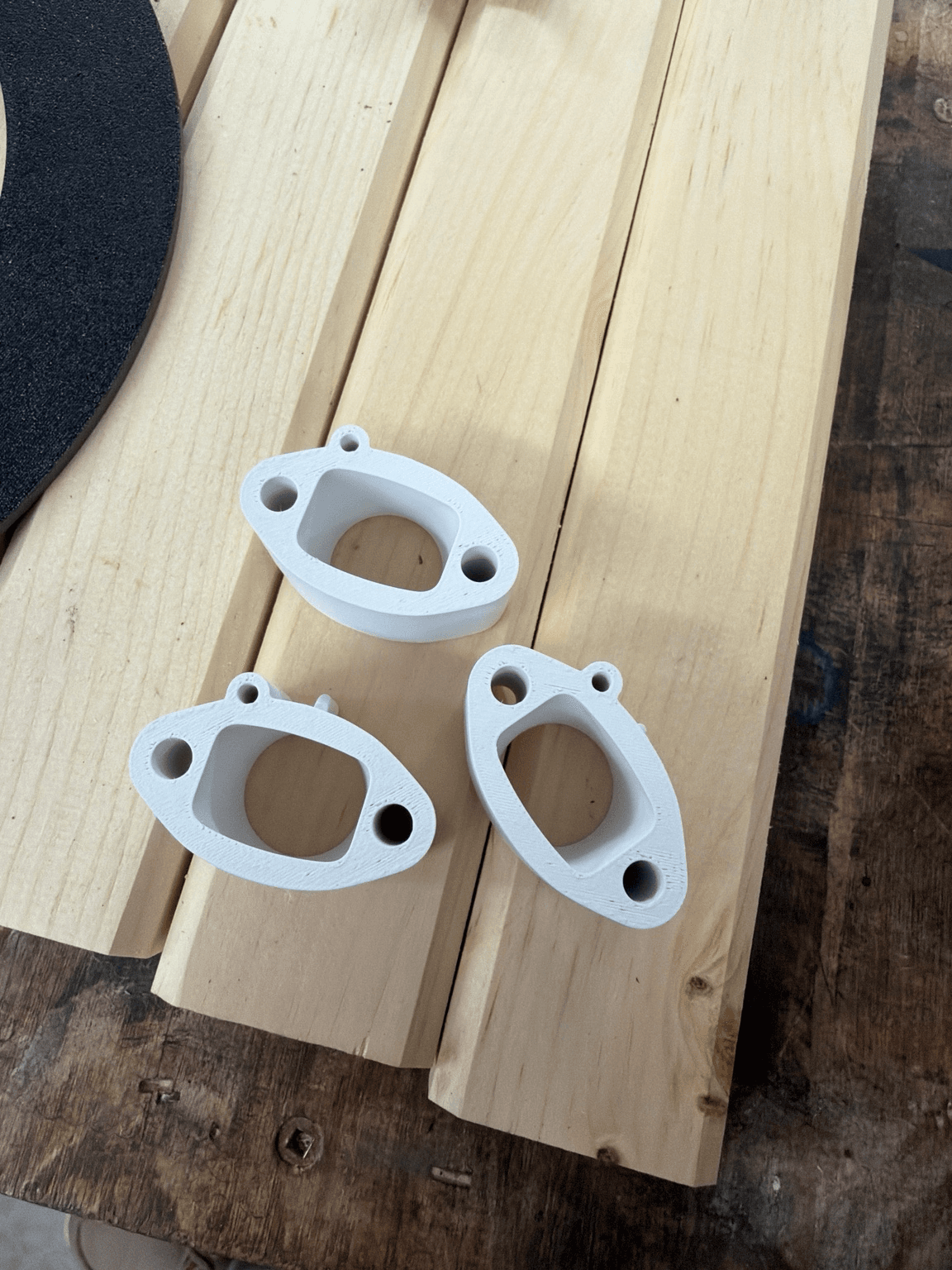
01 / The replicated parts
The workshop photo shows the openings, mounting points and thickness of three replicated parts. These are the details that guide dimensional checks.
02 / On the equipment
A 9-second silent workshop clip. The camera shows the opened chainsaw and its carburettor area, with a white component visible behind the carburettor.
Have a similar part to replace?
Send a photo of the part, a photo of where it fits and the equipment reference. Include opening dimensions, mounting-hole spacing and any known heat or fuel exposure.
Ask about a similar partDevelopment example, available for assessment and quotation only. Model compatibility, final material and application suitability must be confirmed before supply.
These images document this project. They are not a durability test or validation for other models.
From broken sample to repeat supply
Send the part details
Photos, model, quantity and operating conditions. An original or broken sample is especially helpful.
Assess and quote
We review feasibility, material options, design work and production costs for the application.
Make and check a prototype
Where needed, we check dimensions, fit and intended use before proceeding to production.
Supply the approved part or batch
Once the design is approved, we confirm production pricing and options for repeat orders.
Your repair bench. Our design and fabrication.
Repair shops, tool dealers, small-engine specialists and maintenance teams: start with one part you keep needing and can’t source. We assess the geometry and working conditions to establish whether a custom replacement is a practical option.
- One repair or a small batch
- Tell us the quantity for the current repair and your likely repeat demand. We can assess the prototyping and manufacturing steps.
- Design and production priced separately
- Initial design work and the cost of a repeat batch are discussed separately, before any work is authorized.
- Fit starts with the details
- Photograph the part and its mounting location. Add equipment identification, dimensions, fastening details and working conditions.
Which filament fits your part?
Rigid, flexible, weather-resistant or suited to a technical job? Explore the main families, what they are good for and their trade-offs. The sketches show possible applications.
Start with what the part needs to do
14 families shown
How to read costs and properties
$ = economical · $$$$$ = premium specialty. Ranges reflect differences between brands and grades, for filament alone. Design, part volume, printing time and finishing determine the finished-part quote.
Durability depends on geometry, print orientation, loads and exposure. Heat descriptions are qualitative; printing temperature is not operating temperature. We check the specific grade and process for your project.
Relative filament cost · $ → $$$$$
PLAPolylactic acid$
A rigid, easy-to-print plastic that captures small details cleanly.
- Behaviour
- Rigid
- Heat
- Lower resistance
- Outdoors / UV
- Best indoors
- A good starting point for
- Visual prototypes, display pieces, models and lightly loaded indoor parts.
- Durability in practice
- Keeps its shape well in cool conditions, but can crack under impact or repeated bending.
- What to check
- Avoid hot locations and sustained outdoor exposure; modified PLA grades behave differently.
PETGGlycol-modified polyester$
A practical all-round plastic for functional parts, with good layer bonding.
- Behaviour
- Rigid, slightly yielding
- Heat
- Moderate resistance
- Outdoors / UV
- Check exposure and grade
- A good starting point for
- Holders, protective housings, brackets and workshop accessories.
- Durability in practice
- Generally tolerates knocks and bending better than standard PLA; sustained loads can still cause deformation.
- What to check
- Check the grade for prolonged heat, sunlight or chemical exposure. A printed part is not automatically watertight.
ABSAcrylonitrile butadiene styrene$–$$
A tough engineering plastic used for rigid functional components.
- Behaviour
- Rigid and tough
- Heat
- Higher than basic PLA
- Outdoors / UV
- Protect from prolonged UV
- A good starting point for
- Tool housings, fixtures, covers and parts exposed to more heat than basic PLA can handle.
- Durability in practice
- Useful where impact resistance and rigidity matter; prolonged sunlight is a weakness.
- What to check
- Warping, layer bonding and ventilation need process control. For exposed outdoor parts, compare ASA.
ASAAcrylonitrile styrene acrylate$$
A rigid technical plastic selected for weather and sunlight exposure.
- Behaviour
- Rigid
- Heat
- Higher than basic PLA
- Outdoors / UV
- Good UV/weather candidate
- A good starting point for
- Outdoor covers, equipment housings, mounts and exposed fittings.
- Durability in practice
- Combines useful toughness with better UV resistance than ABS, making it a strong outdoor starting point.
- What to check
- Temperature, loading and chemical contact still need review. Enclosed printing helps manage distortion.
TPU / TPEThermoplastic elastomers$$–$$$
Rubber-like plastics that bend and recover; TPU is one family of TPE.
- Behaviour
- Flexible to rubber-like
- Heat
- Grade-dependent
- Outdoors / UV
- Grade-dependent
- A good starting point for
- Protective boots, bumpers, feet, grips and flexible sleeves.
- Durability in practice
- Flexibility helps absorb knocks. Softer grades deform more easily under load; hardness changes the feel substantially.
- What to check
- Choose a hardness and check the exact grade for heat, chemicals, compression and outdoor exposure.
Nylon (PA)Polyamide: PA6, PA12 and related grades$$$
A family of wear-resistant engineering plastics with useful toughness.
- Behaviour
- Tough; flex varies
- Heat
- Often higher; grade-specific
- Outdoors / UV
- Review moisture and UV
- A good starting point for
- Bushings, gears, guides and functional parts that need controlled flex.
- Durability in practice
- Often handles friction and mechanical wear well; moisture can change dimensions and mechanical behaviour.
- What to check
- Nylon types differ substantially. Select the grade, dry it correctly and check how the part is loaded.
PA12-CFCarbon-fibre-reinforced nylon 12$$$$
A reinforced nylon family chosen for stiffness and dimensional control.
- Behaviour
- Stiff
- Heat
- Grade/process-dependent
- Outdoors / UV
- Review the exact grade
- A good starting point for
- Jigs, fixtures, rigid mounting parts and engineering prototypes.
- Durability in practice
- Carbon reinforcement helps resist bending. Performance still depends on layer direction, conditioning and the exact formulation.
- What to check
- Confirm the grade, drying and application loads. The linked manufacturer example is a reference, not an identification of our stock.
Polycarbonate (PC)Polycarbonate and PC blends$$–$$$
A rigid engineering family known for toughness and heat resistance.
- Behaviour
- Rigid and tough
- Heat
- Higher resistance
- Outdoors / UV
- Check UV suitability
- A good starting point for
- Functional housings, fixtures and mechanically demanding prototypes.
- Durability in practice
- Can combine stiffness with impact resistance, but printed strength depends on grade and layer bonding.
- What to check
- PC blends vary. Drying, print conditions and chemical contact need attention; confirm a UV-suitable grade for outdoor service.
Polypropylene (PP)Polypropylene$$$
A lightweight polymer that can bend in thin sections and resists many chemicals.
- Behaviour
- Semi-flexible
- Heat
- Grade-dependent
- Outdoors / UV
- Check UV stabilization
- A good starting point for
- Lightweight components, flexible features and chemical-exposure prototypes.
- Durability in practice
- Useful where low weight and yielding geometry matter; stiffness is lower than many rigid engineering plastics.
- What to check
- Chemical compatibility, UV exposure and sustained loading need grade-specific checks. Printing and adhesion require a suitable process.
CPE / PCTGSpecialty copolyesters$$–$$$
Related polyester families offering different balances of toughness, clarity and chemical resistance.
- Behaviour
- Usually rigid and tough
- Heat
- Depends on formulation
- Outdoors / UV
- Check the selected grade
- A good starting point for
- Functional housings, transparent prototypes and parts needing a different balance than standard PETG.
- Durability in practice
- Some grades prioritize impact resistance; others emphasize processing or chemical performance.
- What to check
- CPE and PCTG are not interchangeable specifications. Compare the exact datasheet and exposure conditions before choosing.
Carbon / glass-filledFibre-reinforced polymer blends$$–$$$$
Carbon or glass fibres added to a base plastic such as nylon, PETG or PC.
- Behaviour
- Usually stiffer
- Heat
- Base/grade-dependent
- Outdoors / UV
- Base/grade-dependent
- A good starting point for
- Stiff fixtures, dimensionally stable housings and technical prototypes.
- Durability in practice
- Fibres can improve stiffness and shape control, but may reduce impact toughness or layer adhesion.
- What to check
- The base polymer still matters. Reinforcement alone does not establish strength, heat limits or outdoor suitability; abrasive blends require suitable hardware.
Wood / metal-filledDecorative particle-filled blends$$–$$$
Usually PLA or PETG mixed with particles to change the look, texture or weight.
- Behaviour
- Textured; varies by blend
- Heat
- Base-polymer dependent
- Outdoors / UV
- Base-polymer dependent
- A good starting point for
- Presentation models, display pieces, handles and decorative surfaces.
- Durability in practice
- The underlying plastic and filler determine performance; a metal-like finish is not a solid-metal part.
- What to check
- Choose these for appearance first. Verify mechanical needs and finishing options; particles can make the filament abrasive or harder to print.
Support filamentsPVA, BVOH, HIPS and support blends$$–$$$$
Temporary materials that support overhangs or hard-to-reach internal geometry during printing.
- Behaviour
- Temporary support
- Heat
- Match the print process
- Outdoors / UV
- Not an end-use comparison
- A good starting point for
- Complex cavities, delicate interfaces and parts where ordinary supports are difficult to remove.
- Durability in practice
- Chosen for removal rather than the finished part’s service life. PVA/BVOH dissolve in water; HIPS uses a different solvent process.
- What to check
- Match support and model materials, moisture control and the removal method before printing.
PEI / PEEK / PPSHigh-temperature engineering polymers$$$$–$$$$$
Distinct advanced polymer families for demanding thermal, chemical and mechanical applications.
- Behaviour
- Rigid engineering polymers
- Heat
- High; exact grade matters
- Outdoors / UV
- Application-specific review
- A good starting point for
- Specialized industrial prototypes and components with carefully defined operating requirements.
- Durability in practice
- Can retain useful properties in conditions beyond common filaments, when grade, geometry and processing are suitable.
- What to check
- These families are not interchangeable. Confirm the exact grade, printer capability, drying, thermal processing and application requirements before quoting.
Deciding between materials? Tell us about loads, heat, sunlight, contact fluids and the flexibility you need. We can assess other materials and order them for your project.
Choose the material around the job.
A broad range of filaments
Our range includes PLA, PETG, ASA, PA12-CF, TPU and many other filaments. We work with a wide variety of materials to suit different parts and project requirements.
- PLA
- PETG
- ASA
- PA12-CF
- TPU
Need a specific material?
We can also order other materials for a special project, after checking availability, machine compatibility and suitability for the application.
High-end printing equipment
Our equipment includes H2C, H3C, X1C and P1S machines. We choose the machine and filament around the geometry and requirements of your project.
Heat, chemicals, mechanical loads, flexibility and sealing requirements guide the choice. We assess the complete part and its operating conditions.
Carbon-fibre-reinforced polyamide 12 (PA12-CF), also called carbon-fibre-reinforced nylon 12, is one material we can assess for a project. Performance claims must match the exact grade used. Fuel resistance in a material does not establish that a printed component will seal reliably.
Temperature, fuel compatibility and load limits are assessed for the particular part; they are not blanket promises.
Before you send your part
Do you work with repair shops and tool dealers?
Yes. We assess one-off parts, small batches and repeat requests for repair shops, tool dealers and maintenance teams. Tell us the part, its job, quantities and recurring needs so we can discuss feasibility and a quote.
What should I send for a discontinued part?
Include the make, model, type code and part reference where available. Photos of the equipment, the part and its mounting points, plus measurements and a sample, help with the assessment. A part reference alone does not confirm compatibility.
Do I need a CAD or 3D file?
No. Photos and a description are enough to start an assessment. A photograph does not establish all manufacturing dimensions, so we may ask for measurements or a sample.
Can you work from a broken sample?
Often, yes. Keep the pieces and photograph where the part fits. We will let you know whether sending or dropping off the sample would help.
Can every part be recreated?
No. Geometry, loads, heat, chemical exposure and safety functions can make a part unsuitable for printing or require another manufacturing method.
How does pricing work?
Design and prototyping may be a separate initial cost. Production can then be quoted per part or batch, based on material, complexity and quantity. Work begins only after the quote is agreed.
Can you supply small batches and repeat orders?
Yes, for approved designs and suitable applications. Tell us the first quantity and likely repeat demand so we can discuss pricing and availability.
How is fitment confirmed?
The make, model, type code, dimensions and a sample help establish the fit. A similar appearance or suspected part number is not a compatibility guarantee.
How long will it take?
Timing depends on design work, prototyping, material and quantity. We confirm an estimate after assessment; receipt of an enquiry does not reserve a production date.
Can I pick up my parts or have them shipped?
Pickup is by appointment in Dieppe. Shipping across Canada can be arranged, with the cost and details confirmed in the quote.