
- mitre joint
- mitre spline
- picture frame joinery
- woodworking
- joinery
Mitre Joint Strength: Splines, Keys, Dominoes, and Fasteners
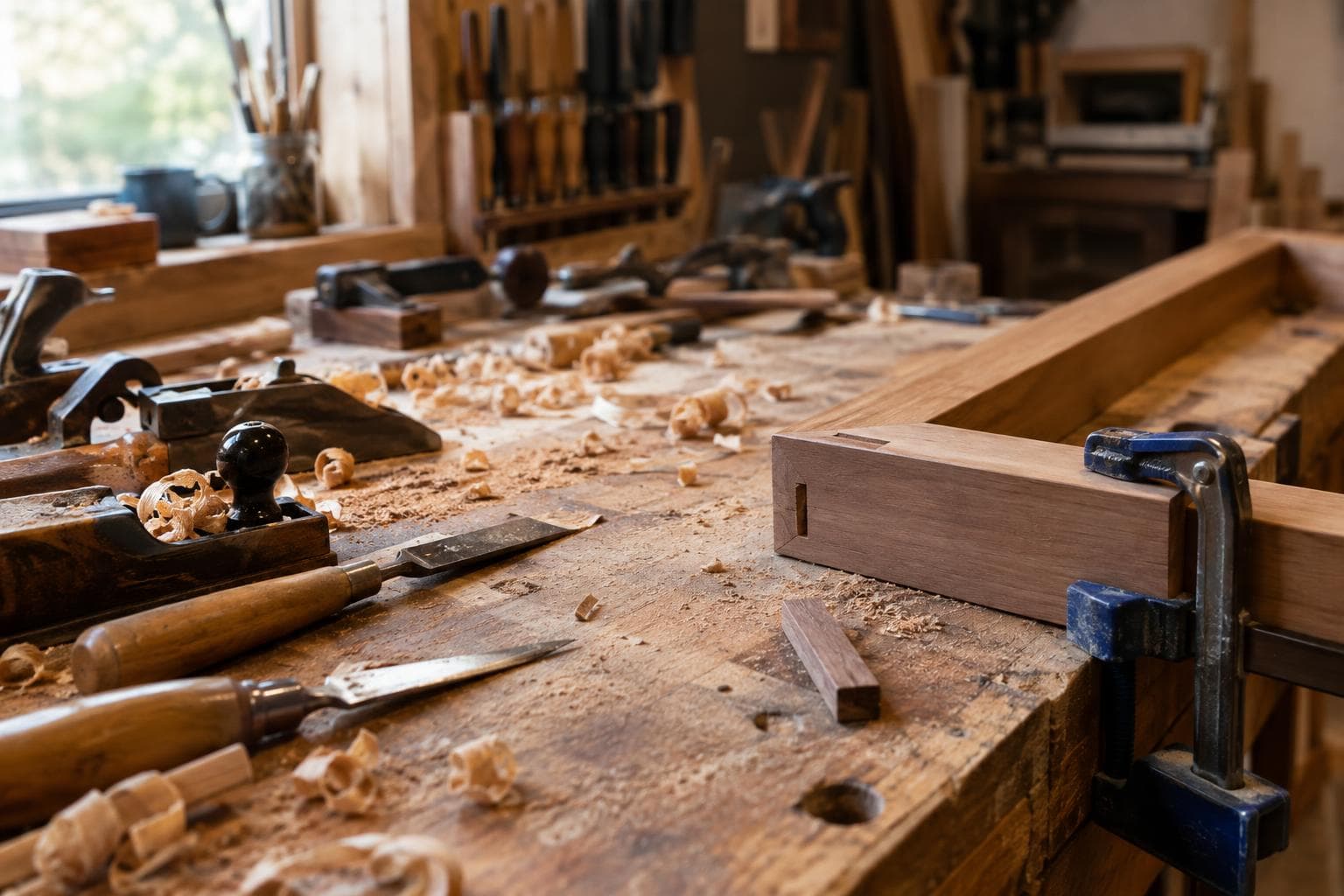
A mitre joint looks strong until the corner is pulled apart and the glue line lets go. The honest answer is that a clean glue-only mitre can work for a lightly handled picture frame, but a spline or key gives the best strength gained for the least added complication.
The choice changes with the part, the wood, the quantity, and whether the reinforcement should be visible. A one-off hardwood frame, a batch of twenty frames, and a wide cabinet moulding do not deserve the same joinery.
Why a glued mitre is weaker than it looks
A mitred corner has a large-looking face, but its fibres do not present the same way as a long-grain edge joint. A forty five degree face is close enough to end grain that a glued mitre holds a fraction of a face joint. The fibres offer less mechanical support than a joint where long grain meets long grain.
That does not make glue-only joinery useless. It works when the parts are stable, the mitres close without force, the glue surfaces are fresh, and the frame will not be dragged around by its corners. It is a reasonable choice for a small decorative frame with a good assembly jig.
The usual failures are not mysterious:
- One mitre is slightly hollow, leaving a glue gap at the front or back.
- The mitre saw leaves a polished or torn surface that does not bond consistently.
- Clamping pressure pulls the corner out of square instead of closing it.
- Seasonal movement opens a weak corner after the finish has already hidden the problem.
- The frame is handled by one corner, loading the joint in a direction glue alone dislikes.
A sharp blade and a reliable stop fix some of these problems. They do not change the grain direction. That is why reinforcement exists.
What a spline or key adds
A spline is a thin piece fitted into a slot that crosses the mitre. A key is a similar idea, often a contrasting piece let into the outside of the corner after assembly.
A spline or key crossing the joint line adds long grain glue surface and mechanical interlock at once. The added long-grain area gives the adhesive a better surface, while the cross-grain piece resists the corner opening. That combination is why a mitre spline usually earns its setup time.
For a picture frame, we normally prefer a spline cut from the back or a small contrasting key cut from the outside, depending on the intended finish. A back spline can disappear under the backing and leaves the front uninterrupted. An exposed key becomes part of the design, but its grain, colour, and fit need to be deliberate.
A spline is not automatically strong just because it is visible. It needs enough depth to engage both frame members, enough width to avoid splitting the mitred tips, and grain running along the spline rather than across its thin dimension. A slot too close to the outside edge can break out during cutting or leave a weak strip of wood beside the joint.
For a single frame, a router table, slotting jig, or carefully controlled saw setup may take longer to arrange than the joint itself. For repeated frames, the same setup becomes cheap in time because each corner follows the same path.
Comparing the four reinforcement methods
| Method | Setup and assembly time | Strength added at the joint | Front-surface finish | Cost per part and common failure |
|---|---|---|---|---|
| Spline | Moderate setup, fast once the slot jig is established | High for its size because it combines long-grain glue area with mechanical interlock | Invisible from the front when cut from the back; decorative when exposed | Low after setup; slot breakout or loose spline fit is the usual failure |
| Key | Moderate cutting and fitting time | High, with strong resistance to the corner opening if the key crosses both members | Deliberately visible and easy to make part of the design | Low to moderate; poor grain match or a shallow key looks like a repair |
| Domino or loose tenon | High on narrow rails; fast on suitable wide stock with a repeatable fence | High when the tenon has adequate surrounding wood and correct grain direction | Fully hidden, with no front patch | Moderate to high; insufficient edge distance, poor registration, or a tenon that weakens the mitre |
| Hidden pin, staple, or similar fastener | Very fast for small batches and repairs; little dedicated setup | Moderate; holds alignment and resists opening, but adds less long-grain glue area than a spline | Hidden from the front, though the back may show the entry point | Low; short grain, shallow purchase, or a fastener too close to the edge can split the corner |
| Glue-only mitre | Fastest if the saw, jig, and clamping method are already trustworthy | Low to moderate for a light, stable frame; dependent on the glue line | Cleanest possible appearance | Lowest; the corner opens if the fit, clamping, or handling load is poor |
The ranking for most hobbyist picture frames is straightforward: spline first, key second, hidden fastener third, and glue-only last when the frame will be handled often. Dominoes can move into first place on wide rails or larger assemblies, but they are not automatically the best answer for narrow moulding.
Why dominoes are not always the upgrade
A loose tenon crosses the mitre and can provide a strong hidden connection. The problem is scale. A standard loose-tenon cutter needs enough material around the mortise. Narrow frame rails may not have the width or thickness to accept a mortise without bringing the cutter too close to an edge.
A domino-style joint also demands accurate registration. The mortises must land in the matching positions on both mitres, and the parts must remain aligned while the glue sets.
For wide rails, thick cabinet parts, or a repeatable production jig, a loose tenon is a sound choice. It is fast to repeat and stays hidden. For a small frame with rails that barely accommodate the mortise, a spline gives similar practical security with less risk and less special setup.
This is the part that is against buying another tool: do not buy a loose-tenon machine for a handful of small picture frames. A spline jig or a concealed pin can solve the actual problem at lower cost and with less material risk. The upgrade fixes a capacity problem you may not have.
Choosing by quantity, finish, and failure risk
For one to three frames, glue-only is acceptable when the frame is small, the corners close without pressure, and the piece will not be used as a handle. If the frame has valuable glass, a heavy backing, or frequent handling, a concealed spline is cheap insurance even for one frame.
At roughly four to ten identical frames, a spline jig usually becomes the best balance. The setup is spread across enough corners to justify careful alignment, and the joint remains hidden from the front. A key is faster to inspect and can add a deliberate design mark, but matching the key stock across every corner takes its own time.
At higher quantities, repeatability matters more than the theoretical strength of any one joint. Use stops for the mitre cuts, a fixed reference face for the spline slot, and a dry-fit check before glue. If every corner gets the same slot, a spline remains efficient. If the rails are wide enough for a loose tenon and the mortising setup is already dialled in, dominoes can overtake splines on assembly time.
Hidden fasteners make sense where the back will be covered, the frame is light, and the main need is keeping the mitres aligned during glue-up. They are a poor substitute for a spline when the corner will receive repeated impact or twisting. A pin can hold a joint closed while the adhesive cures; it does not create the same broad long-grain connection.
Before choosing, check these points:
- Measure the narrowest rail, not the widest one, before selecting a tenon or slot size.
- Keep the reinforcement far enough from the outside edges to avoid splitting, with the actual margin set by the wood species and stock thickness.
- Test the cutter and adhesive on offcuts from the same board.
- Dry-fit every reinforced corner before spreading glue.
- Mark one reference face so the reinforcement cannot quietly shift to different sides from corner to corner.
- If the key or spline will show, make the test joint before cutting the finished frame.
The method we would pick
For a normal wooden picture frame with small or medium rails, we would pick a back-cut mitre spline. It adds long-grain glue surface and mechanical interlock, stays out of sight, scales well from one frame to a small batch, and does not require a mortise that may weaken a narrow rail.
We would use an exposed key when the design benefits from a visible accent or when the frame is thick enough to make the key substantial. We would choose a loose tenon for wide rails, deep mouldings, or a repeatable batch where the mortising setup is already in place. We would use a hidden pin when speed and alignment matter more than maximum joint strength.
Glue-only remains the right answer for a small, lightly handled frame with clean mitres. Extra joinery is not free. It adds cutting, fitting, glue-up decisions, and more chances to mark the finished piece. Reinforce the corner when the part needs reinforcement, not because every mitre must display a technique.
Frequently asked questions
Is a mitre spline stronger than a biscuit?
Usually, yes for a small mitred corner, because the spline can be sized to cross the joint and provide a longer, more direct connection. A biscuit can help with alignment and adds some glue area, but its thin compressed material and shallow engagement are not automatically better than a properly fitted spline.
Can I use a domino in a narrow picture frame?
Only if the rail has enough width and thickness to leave sound wood around the mortise. Check the cutter's actual mortise size, the tenon's dimensions, and the edge margins on scrap from the same stock. If the mortise leaves a thin strip beside the mitre, use a spline or hidden fastener instead.
Should the spline grain run with the frame or across it?
The spline's long grain should run along the spline, crossing the joint line between the two frame members. That orientation supplies the long-grain glue surfaces and mechanical interlock that make the reinforcement useful.
We build made-to-order picture frames and related joinery through custom woodworking.
Related services
All services →Have a project in mind?
Tell us what you want built — we reply within 24–48 hours.