
- production planning
- lead time planning
- maker business
- deadline scheduling
- shop workflow
Production Planning: Count Backward From Your Deadline
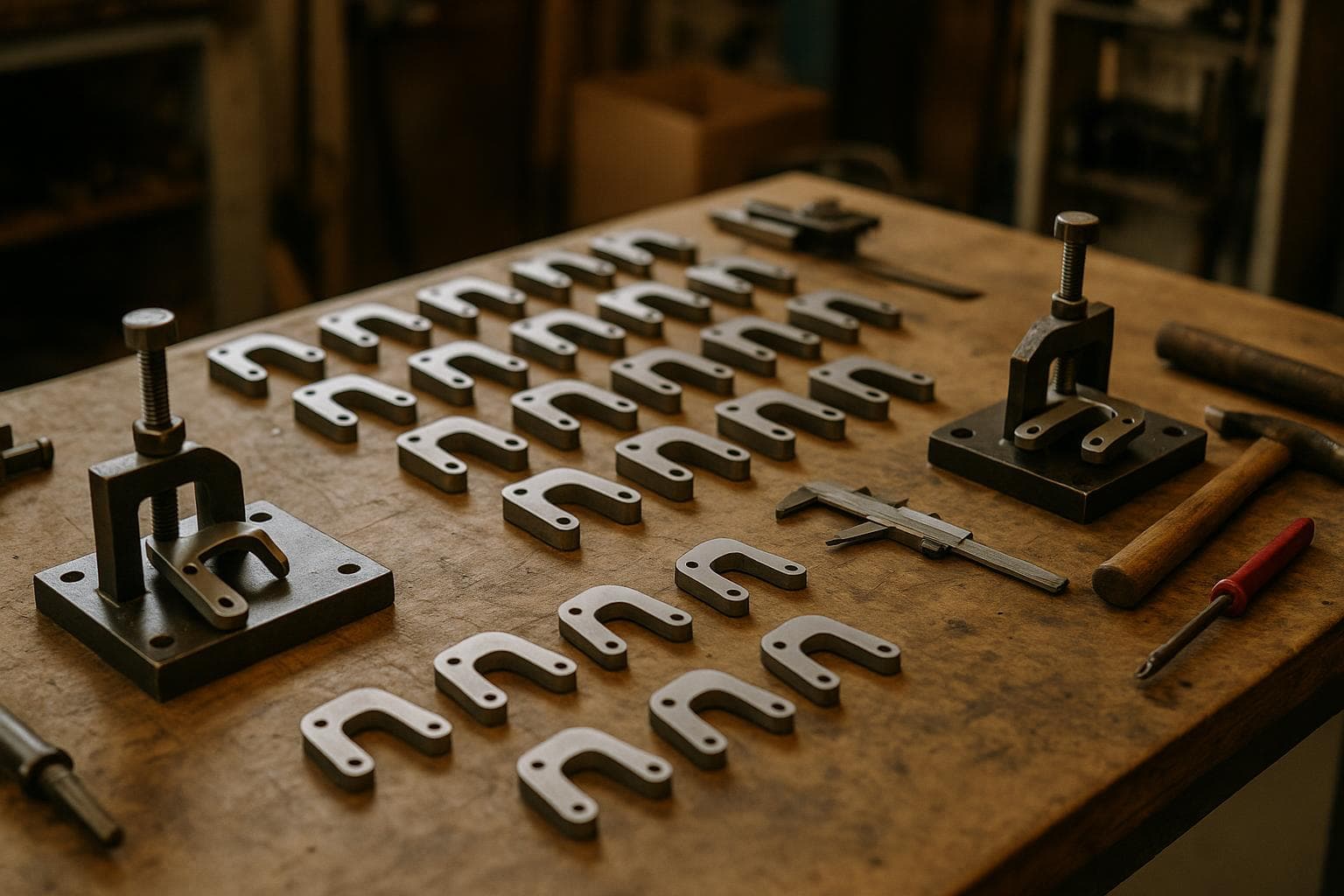
A deadline is not the day you want to start making. It is the day the finished work must already be usable, inspected, and accounted for. The reliable method is to start at that date and count backward through production, testing, material delivery, and recovery time; a schedule built forward from today hides the slack it does not have.
Set the real deadline before scheduling
Write down the first date and time the work is needed. Do not use the date someone hopes to see progress, the date a machine could start, or the date you would like to ship. If the parts must be assembled, installed, photographed, packed, or checked by a third party, those activities belong before the deadline.
Use one of these as the finish point:
- The finished part passes its functional check and is ready for its next operation.
- The complete batch is counted, sorted, labelled, and ready for handoff.
- The assembled item has passed its fit, electrical, or operating test.
Then write the quantity that must pass, not the quantity you intend to make. If the requirement is 40 usable parts, a plan for exactly 40 parts has no allowance for scrap. Add a stated overrun based on the process risk and the cost of repeating the run. A small overrun is usually cheaper than discovering at inspection that one failed part has consumed the entire reserve.
List the work in reverse order
Start with the last operation and move backward one dependency at a time. Include operations that are often left out of a forward schedule:
- Final inspection, count, and handoff preparation.
- Assembly, wiring, finishing, or installation.
- Cleaning, deburring, sanding, curing, or cooling as required by the material and process.
- The full production run, including loading, unloading, tool changes, pauses, and measurement.
- A test cut or test print using the actual material, tooling, and machine settings.
- File preparation, fixture setup, toolpath review, machine setup, and first-piece inspection.
- Material receipt, inspection, acclimation, drying, or conditioning where the process requires it.
- Ordering and supplier confirmation, with a response window if the first source cannot meet the date.
Give every step a duration and a dependency. “Cut parts” is not a useful task until it says which file, which material, which fixture, how many pieces, and what happens if the first piece fails inspection.
Material delivery and machine downtime are the two hardest items to compress. A late sheet, spool, board, or electronic component cannot be made up by increasing feed rate. A machine that is unavailable cannot be recovered by adding optimism to the calendar. Put both into the schedule as fixed risks rather than treating them as ordinary production time.
Calculate the backward dates
Use the deadline as the finish date for the last task. Subtract the duration of that task to find the latest finish for the task before it. Continue until the first action is dated.
For each task, record:
- Latest finish: the date and time the task must be complete.
- Duration: hands-on time plus waiting, cooling, curing, or machine occupancy.
- Dependency: what must be available before the task can begin.
- Verification: the observation or measurement that allows the next task to start.
- Recovery allowance: time for the first expected correction or failed attempt.
Keep calendar time separate from machine time. A six-hour print may occupy a machine overnight but require only brief operator checks. A cut file may run for 20 minutes yet consume half a day once setup, test cuts, dust removal, and inspection are included. Scheduling only the number shown in the CAM estimate or slicer estimate is one of the common ways a production planning maker loses a day.
Separate fixed windows from flexible work
Mark tasks that cannot move or shrink. These commonly include supplier transit, machine repair, material conditioning, adhesive or finish cure, and a booked inspection. Mark tasks that can move, such as file cleanup, fixture preparation, and documentation. Flexible work can fill waiting periods, but it must not be counted twice as both preparation and recovery time.
Use working days for operator tasks and elapsed time for delivery and curing. A weekend may be available for an unattended machine run, but it does not make a supplier deliver sooner or make a finish cure faster. If the actual availability of the machine is uncertain, schedule the work against its confirmed availability rather than its nominal capacity.
Add the first-run failure on purpose
Every new combination of file, material, tool, fixture, and machine deserves a first-run failure allowance. That does not mean assuming the whole batch will fail. It means accepting that the first test often reveals a fit error, wrong origin, unsuitable hold-down, material movement, excessive heat, poor layer bonding, or a dimension that was correct in the drawing but wrong in use.
The failure window belongs before production, not after the deadline. For a repeat job with unchanged files, material, and setup, the allowance can be smaller. For a new setup, unfamiliar stock, or a process with long machine time, reserve enough time to make one correction and repeat the test. Do not call that time “slack” and spend it on another task. It is part of the operation.
| Production stage | Hard dependency | Typical failure mode | Can time be compressed? |
|---|---|---|---|
| Material receipt and inspection | Correct stock has arrived and matches the drawing | Wrong thickness, warped stock, damaged surface, missing components | Rarely; an alternative source may change the material and require a new test |
| Test cut or test print | Actual material, tool, file, and machine are available | Poor fit, heat damage, stringing, tear-out, weak layers, wrong origin | Sometimes, but skipping it moves the failure into the batch |
| Machine setup and first-piece check | Fixture, tooling, workholding, and reference points are verified | Part shifts, tool length is wrong, dimensions drift, wiring is reversed | Setup can be prepared early; verification should not be rushed |
| Main production run | Approved first piece and stable machine | Tool wear, material movement, jam, power loss, operator error | Only within the limits of the material, machine, and process |
| Inspection and recovery | Complete or nearly complete batch | Quantity shortfall or a defect found too late | Rework may be possible; curing, delivery, and downtime usually are not |
A test is useful only if it has a pass condition. Write the condition before running it. “Looks good” is not a gate because it changes after time pressure arrives.
A practical gate records:
- Critical dimensions and their allowed tolerance.
- The reference edge, datum, or origin used for measurement.
- Fit with the mating part, not just a measurement with calipers.
- Surface or edge defects that make the part unacceptable.
- Machine settings and file revision used for the test.
- The decision: release, adjust and repeat, or stop and investigate.
Measure the feature that controls the next operation. If parts will be assembled, test assembly. If a cut part must fit a recess, use the real recess or a gauge representing it. If an electronic board controls a load, test the input, output, polarity, and expected operating state before connecting the complete system. A measurement that does not represent use can pass while the finished batch fails.
After the first piece passes, freeze the approved file, setup notes, material identification, and key settings. Then start the batch. Do not make an unrecorded adjustment halfway through because it creates two undocumented versions and makes the inspection result difficult to trust.
Audit the schedule before committing
Perform a reverse audit from the deadline. Read each row from the last task back to the first and ask whether its required input will exist at that exact time. The schedule passes only if every answer is yes and the recovery allowance has not been quietly reassigned.
Look especially for these gaps:
- Delivery is listed as a date, but there is no receipt or material inspection time.
- Machine runtime is listed, but loading, setup, cooling, unloading, and cleanup are absent.
- The test cut exists, but there is no time to change the file and repeat it.
- The batch quantity is exact, with no allowance for rejected parts.
- A repair or maintenance window is treated as available production time.
- Inspection is placed after the handoff instead of before it.
- A dependency is assumed to be available without confirmation.
Our final check is a simple one: cover the current date and read the plan backward from the first-needed date. If any step has no dated predecessor, no measurable pass condition, or no owner, the plan is not finished. Move the start earlier, reduce the scope, change the process, or renegotiate the deadline before material and machine time are committed.
Forward scheduling is useful for estimating how soon an uncommitted project might finish. It is poor protection for a fixed deadline because it starts with today and treats every future gap as available. Backward scheduling exposes those gaps before they become emergencies. That is the point of lead time planning: not predicting a perfect run, but proving that the run still works after delivery, testing, and the first correction have been given their proper place.
Frequently asked questions
How much buffer should a production run have?
There is no universal percentage. Base the allowance on the longest credible failure and the availability of the machine and material. A repeat setup with a verified process needs less recovery time than a new material, new fixture, or long unattended run. Reserve time for one correction before production, then add more if a failed run would require another delivery or a repair.
Should I schedule from machine time or operator time?
Use both. Machine time determines when the equipment is occupied, while operator time determines whether loading, checks, changes, and inspection can happen. The schedule must satisfy both clocks. A machine can run unattended only if the process is already proven and the consequences of an interruption are acceptable.
What should I do if the backward schedule starts before today?
Do not hide the deficit by removing the test or delivery allowance. Identify the fixed constraint first. Then reduce quantity, simplify the process, use an already verified setup, secure an alternate material, or move the deadline. A plan that reaches the date only by assuming zero failures is not a plan.
The Boss Factory builds made-to-order work in Custom Woodworking, Laser Cutting & Engraving, and CNC & Precision Cutting; request a quote.
Related services
All services →
Have a project in mind?
Tell us what you want built — we reply within 24–48 hours.