
- cnc
- router bits
- cnc starter bits
- woodworking
- maker tools
CNC Starter Bits: Five Cutters for Most Flat Work
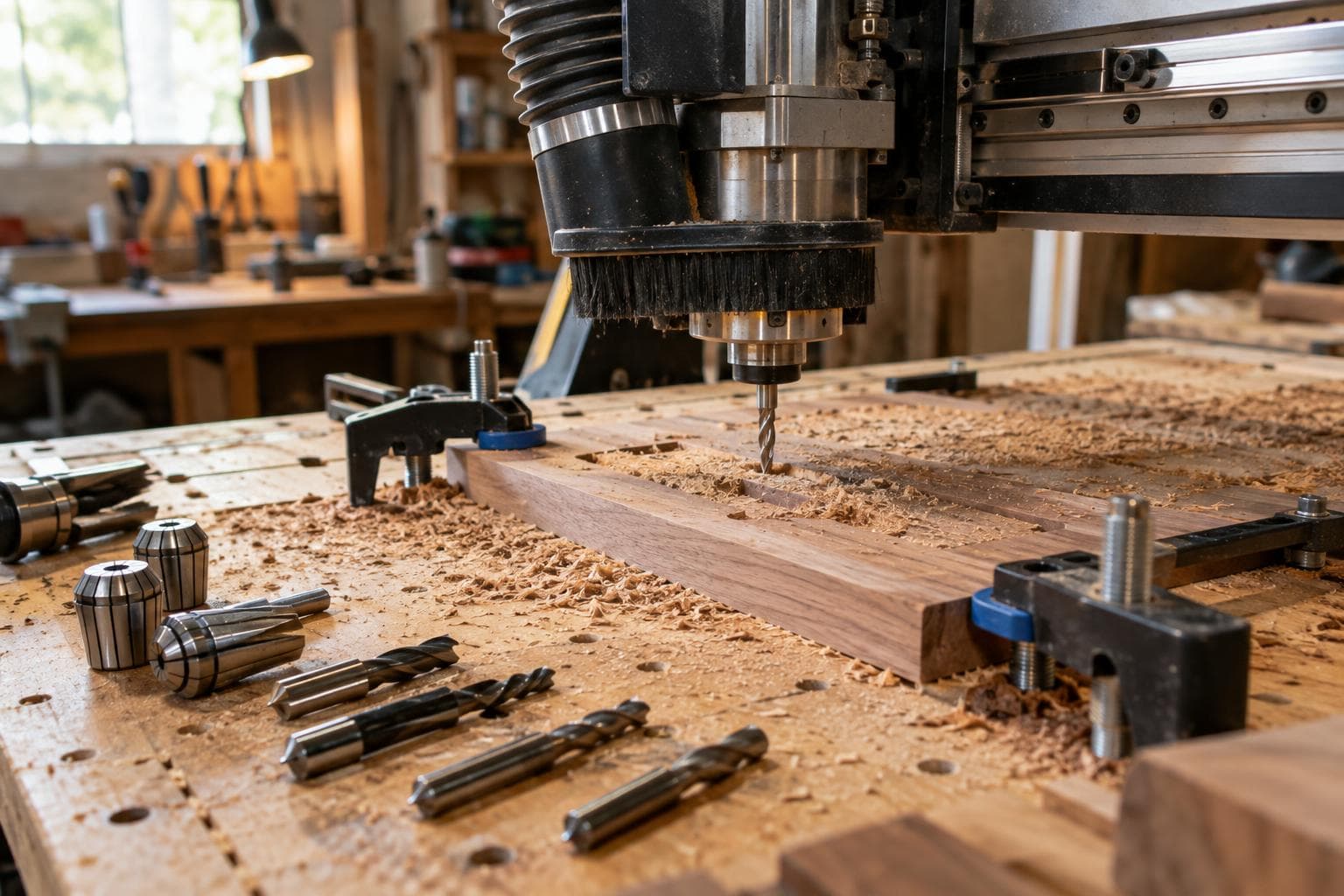
The useful question is not which router bits exist, but which ones earn their place beside a beginner’s machine. A quarter-inch upcut, an eighth-inch upcut, a downcut, a 60-degree V-bit, and a ball nose cover most flat work before any specialty cutter is justified.
The order matters. Each cutter should solve a job, expose a particular machine or programming problem, and pay for itself in knowledge before the next one arrives.
Start with a quarter-inch upcut
This is the first CNC starter bit we would buy for a router that accepts quarter-inch shanks. Use it for outside profiles, pockets, dados, holes that will be cleaned up later, and roughing stock from sheet goods. The upcut geometry lifts chips out of the kerf, which makes it a practical first choice for materials that produce chips rather than a dusty powder.
Your first useful project should be a flat spoilboard fixture, a simple material hold-down pattern, or a small tray with square pockets. The project should contain an outside contour, an inside pocket, a few holes, and at least one change in depth. That combination teaches workholding, zeroing, toolpath order, depth control, and how a cut edge changes when the bit is pushed too hard.
Plan on roughly two to four hours for drawing, setup, test cuts, and cleanup, not counting the machine’s cutting time. The bit usually costs about $20 to $40, depending on carbide grade, coating, shank size, and seller. A basic solid-carbide bit from a reputable source is adequate for learning; a premium coating does not repair loose workholding or an incorrect plunge rate.
Start conservatively with the feed and depth settings recommended for the specific bit and material. A shallow pass that makes clean chips is more useful than a deep pass that makes the machine complain. Increase feed or depth one variable at a time, then inspect the top edge, bottom edge, chip shape, and bit temperature. A hot bit, melted plastic, darkened wood, or a change in spindle sound means the cutting conditions need work.
Add the eighth-inch upcut for detail
Buy the eighth-inch upcut after the quarter-inch tool is producing repeatable pockets and profiles. It reaches tighter inside corners and cuts smaller lettering, slots, and radii, but it is less forgiving. The smaller diameter has less cross-sectional area and usually needs a lighter cut. Treating it like the quarter-inch cutter is a reliable way to break it.
Use a simple sign panel, a small nameplate, or a fixture with narrow slots as the second project. Keep the design flat. The point is to learn how tool diameter changes corner radius, how small features disappear through over-cutting, and how the same feed rate can be too aggressive for a smaller cutter.
Budget about $15 to $30 for the bit and another two to five hours of practice and setup. That time includes measuring the actual cutter diameter, checking the tool library, making a test square, and confirming that the narrowest feature in the drawing is not smaller than the bit can physically cut.
An eighth-inch tool is not automatically the right answer for fine lettering. If the lettering is too small for the tool, change the design or use a V-bit for an engraved result. Do not keep lowering the size of the cutter until the machine is carrying a fragile needle through a job that should have been redesigned.
Use a downcut when the top edge matters
A downcut bit pushes chips and fibers toward the work surface instead of lifting them out. That often leaves a cleaner top edge in plywood, veneered sheet goods, and other materials where exposed top fibers are a concern. It also packs chips into the kerf, so deep pockets and full-depth profiles need particular care with chip evacuation and heat.
The third project should be a panel with a visible top face: a shallow sign blank, a pocketed organizer, or a small enclosure plate. Compare a short test cut with the upcut and downcut rather than trusting a general claim about edge quality.
Expect about $20 to $40 for the cutter and two to four hours to test it properly. A downcut is not a replacement for the upcut. It is a targeted tool for a top-edge problem. If the top edge is already acceptable, buying one early adds cost without adding capability.
The common failure is a clean-looking top edge with a burned pocket or packed chips below it. Use shallow passes when the pocket is deep, clear chips between tests, and watch for heat rather than judging the cut from its surface alone. A compression bit can solve a particular through-cut edge problem in layered sheet goods, but do not buy one yet. The downcut and upcut usually reveal whether that problem exists on your machine and material.
Put the 60-degree V-bit and ball nose to work
A 60-degree V-bit earns its place for engraved lines, borders, simple lettering, and chamfered edges. Its cutting width changes with depth, so a small Z error can make an engraved line visibly wider or narrower. That makes it a useful lesson in surface probing, stock thickness, and consistent zeroing.
Plan on $15 to $30 for the V-bit and two to four hours for a test panel. Make several lines at different depths, then measure the visible width and inspect the point of the V for damage. For lettering, check the minimum stroke width in the design against the depth and included angle. A V-bit is not a substitute for a small end mill when the lettering must have vertical walls.
The ball nose belongs after the flat tools because it is mainly a three-dimensional finishing cutter. It can also make rounded grooves and blended edges, but its main value appears in contoured surfaces rather than ordinary two-dimensional profiles. Choose a simple shallow relief or a rounded tray surface for its first test.
Budget about $20 to $40 and three to six hours, including toolpath simulation and inspection of the surface under a raking light. The toolpath stepover controls the visible scallops. Smaller stepover improves the surface but increases cutting time, so this is where a beginner first sees a direct trade between finish and hours at the machine.
A ball nose is unnecessary for a flat sign, flat panel, or ordinary pocket. It is a specialty cutter until the design contains a curved surface that the flat tools cannot produce.
| Cutter | Cutting behavior | First useful jobs | Common failure mode | Practice time after setup |
|---|---|---|---|---|
| Quarter-inch upcut | Lifts chips and cuts general profiles and pockets | Fixture, tray, outside contour | Excessive heat, loose work, or a ragged bottom edge | 2–4 hours |
| Eighth-inch upcut | Reaches tighter corners with a lighter cut | Small slots, fine pockets, compact lettering | Broken tool or features too small to survive | 2–5 hours |
| Quarter-inch downcut | Presses fibers down for a cleaner top edge | Visible-face panels and shallow pockets | Packed chips and heat in deep cuts | 2–4 hours |
| 60-degree V-bit | Engraves a width that changes with depth | Lines, borders, lettering, chamfers | Uneven line width from Z or stock variation | 2–4 hours |
| Ball nose | Leaves a rounded profile for 3D surfaces | Shallow reliefs and contoured trays | Visible scallops or a flat-looking surface | 3–6 hours |
Buy the next cutter only for a named problem
Once these five tools work, stop expanding the drawer by category. Add a cutter when a drawing, material, or finish requirement makes the need explicit. That rule protects both money and machine time.
Before buying, write down:
- The smallest inside radius the design requires.
- Whether the important edge is on the top, bottom, or both faces.
- The material and its thickness, including glue lines or a veneer layer.
- The required depth, pass depth, and available chip clearance.
- Whether the job needs a flat wall, a V-shaped groove, or a curved surface.
- The failure that the new cutter is meant to prevent.
A specialty bit should answer one of those points. A compression cutter is for a demonstrated need for cleaner top and bottom edges in suitable sheet goods. A larger diameter cutter is for removing material faster when the machine and workholding can handle it. A tapered ball nose is for a particular relief or lettering geometry, not for making a tool collection look complete.
Track the first usable result rather than the number of bits owned. Record the actual cutter diameter, material, spindle speed, feed, depth per pass, stepover, and what the edge looked like. Speeds and feeds are machine- and material-dependent, so a result from one router is a starting point for another, not a universal setting. The test is a small square, pocket, or line cut in the same material, followed by inspection of chips, heat, edge quality, and dimensional accuracy.
The small tool set covers most two-dimensional work before any specialty cutter. That is the useful stopping point: five tools, a repeatable test method, and enough evidence to know what the sixth tool must fix.
Frequently asked questions
Which router bits should a beginner buy first for CNC work?
Buy a quarter-inch upcut first, then an eighth-inch upcut, a downcut, a 60-degree V-bit, and a ball nose as the work calls for them. The first four handle most flat profiles, pockets, fine details, and engraving; the ball nose covers shallow curved work.
Is a compression bit necessary for a first CNC router?
Usually not. It is useful when a suitable sheet material needs cleaner edges on both faces during a through-cut. Prove that the upcut and downcut tools cannot meet the edge requirement before buying one, because a compression bit adds another setup and does not solve poor workholding or incorrect cutting conditions.
How do I know whether a CNC cutter is too small?
Compare the tool diameter with the smallest slot, inside radius, and lettering stroke in the drawing. Then make a test cut at the planned depth and feed. If the bit deflects, heats up, breaks, or forces the design below a practical feature size, use a larger tool or revise the geometry instead of lowering settings indefinitely.
The Boss Factory builds made-to-order custom woodworking and CNC precision cutting; request a quote.
Related services
All services →Have a project in mind?
Tell us what you want built — we reply within 24–48 hours.