
- enclosure filtration
- printer air filter
- hepa filter
- activated carbon
- laser safety
Enclosure Filtration: HEPA, Carbon, and Exhaust
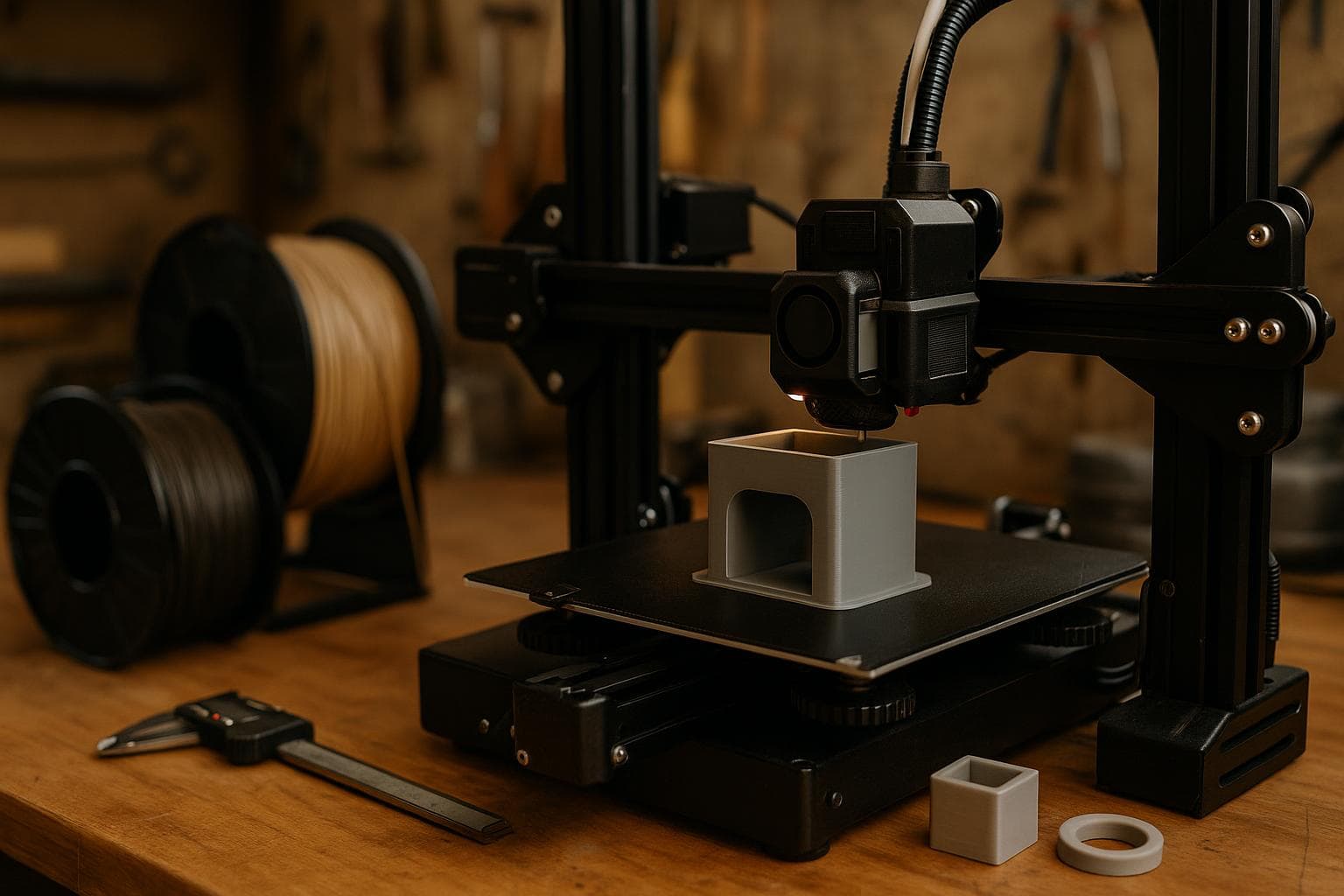
A printer air filter can make the air inside an enclosure cleaner without making the process safe by itself. The short answer is that particulate filters and activated carbon address different contaminants, and neither replaces extraction to outside when the source can be removed.
What enclosure filtration is controlling
Start with the hazard, not the filter name. A laser, CNC machine, or 3D printer can produce several contaminants at once:
- Particles: dust, smoke, soot, and condensate droplets that remain suspended or settle on surfaces.
- Ultrafine particles: very small particles produced by thermal processing and some polymer printing. Their size makes source capture and a properly rated filter important.
- Gases and vapours: volatile organic compounds, aldehydes, acids, and other airborne chemicals released by heated or burned material.
- Combustible dust: fine wood or plastic dust that can burn rapidly if dispersed and ignited. A filter does not make a poor dust-collection layout safe.
Particles harm through inhalation and deposition in the respiratory system. Gases can irritate tissue, affect the nervous system, or create longer-term exposure risks depending on the chemical and dose. The material safety data sheet, supplier data, and machine manufacturer are the right sources for identifying the specific emissions. A smell is not a reliable exposure meter, and the absence of a smell is not proof that the air is clean.
The first control is to stop the contaminant at the source. For a laser or enclosed printer, that means a sealed enclosure with controlled airflow and a discharge path. For CNC dust, it means capture at the cutter and an appropriate dust collector. Room filtration is downstream control and should not be asked to do the source collector's job.
HEPA catches particles, not vapour
A particulate filter, including a HEPA filter, removes particles by forcing air through a fine fibrous medium. The rating matters: check the manufacturer's data sheet for the tested efficiency, test particle size, airflow, pressure drop, and filter class. “HEPA” printed on a housing is not enough to establish how the complete assembly performs.
A filter can also be rated at an airflow that your fan cannot maintain once the filter loads with dust. A small blower moving air freely in a catalogue test may move much less air through a dense filter, a carbon stage, a grille, and a dirty prefilter. The relevant figure is the airflow through the assembled system at its actual resistance.
HEPA media are suited to the particulate portion of smoke and dust. They do not adsorb gases such as solvent vapour or the volatile compounds released by heated plastics. A HEPA stage can therefore make an enclosure look clean while gas-phase contamination remains.
Use a sacrificial prefilter before fine particulate media. It catches larger dust, protects the expensive stage, and gives you a visible maintenance point. Replace it when the manufacturer's pressure-drop limit is reached, when airflow falls below the required value, or when inspection shows loading. A timer is a poor substitute because dust loading depends on material, cut time, enclosure leakage, and capture airflow.
Activated carbon catches gases by adsorption
Activated carbon addresses gas-phase contaminants through adsorption: molecules attach to the carbon's internal surface. It is not a particulate filter, and it does not replace one. A hepa carbon filter is a combination of two different control stages, not a single medium that catches everything.
Carbon performance depends on the chemical, carbon mass, bed depth, airflow, temperature, humidity, and contact time. A thin carbon sheet in a compact printer filter may reduce odour while providing little capacity for a sustained emission. The manufacturer's data should identify the target contaminant and test conditions. If it does not state what was tested, at what concentration, and for how long, treat the gas claim as unverified.
Carbon eventually reaches breakthrough. Once its adsorption sites are occupied, the contaminant passes through even though the fan is still running and the filter looks normal. Odour can be a late or unreliable indicator, so set a replacement interval from the manufacturer's capacity information where available. If that information is missing, use measured airflow, exposure assessment, and the material's hazard data rather than guessing from a calendar reminder.
Humidity can reduce adsorption performance for some compounds by competing for active sites. Heat can also change the result. Keep the carbon stage within the conditions specified by its manufacturer, and do not assume that carbon intended for general odour control has been tested for the emissions from a particular resin, coating, adhesive, or sheet material.
Why outside exhaust remains the stronger control
A recirculating filter reduces the concentration inside the enclosure or room. It does not remove the source. Contaminants still enter the enclosure air, the carbon still approaches breakthrough, and a leak or door opening still releases some of that air into the room.
Extraction to outside removes contaminated air from the occupied space instead of repeatedly processing it. That is the control we would choose when the machine and building allow it, provided the discharge location, make-up air, weather protection, noise, and local requirements are handled correctly. The exhaust system must still prevent contaminated air from leaking through joints and must not discharge near an intake, window, or occupied area.
A negative-pressure enclosure is useful because leakage tends to move inward. It does not guarantee capture at the emission point. Excessive negative pressure can reduce machine cooling, disturb a laser's process, or pull contaminated air out when the door opens. Measure the actual airflow and check the enclosure with a smoke pencil or another suitable airflow test; do not infer performance from fan noise.
If outside exhaust is impossible, recirculation is a reduction measure, not permission to process every material. Use a sealed enclosure, separate particulate and gas stages, monitor filter loading, and follow the material and machine manufacturer's restrictions. PVC and unknown plastics are particularly poor candidates for casual indoor processing because their decomposition products may be corrosive or toxic, and ordinary activated carbon is not a blanket solution.
Choosing the control by contaminant
| Control or stage | Main contaminant addressed | What determines performance | Common failure mode |
|---|---|---|---|
| Source extraction to outside | Contaminated enclosure air, including particles and gases carried in that air | Capture velocity, enclosure leakage, duct resistance, discharge location, and make-up air | The source is not captured, or exhaust leaks back into the room |
| Particulate prefilter | Coarse dust and larger debris | Media area, loading, airflow, and replacement pressure drop | Fine filter loads early or airflow falls sharply |
| HEPA particulate stage | Fine and ultrafine particles within its tested rating | Manufacturer's efficiency test, face velocity, seal quality, and pressure drop | Air bypasses the media, or the fan cannot maintain required airflow |
| Activated carbon stage | Some gases and vapours by adsorption | Carbon mass, bed depth, chemical, humidity, temperature, airflow, and contact time | Breakthrough occurs while the filter still looks clean |
| HEPA plus carbon recirculation | Particles plus some gases, with separate limitations for each stage | All conditions above, plus enclosure leakage and room air exchange | Concentration falls but the emission source remains and capacity is exhausted |
The table is a control comparison, not a promise that any filter handles every emission. Match the material's hazard information to the manufacturer's filter data. A carbon filter rated for one vapour should not be treated as rated for an unrelated chemical.
For a small enclosed process, our priority order is source capture, a sealed airflow path, a coarse prefilter, a correctly rated particulate stage, and then enough activated carbon for the identified gases. We would rather have a measured, lower-flow system that maintains capture than a loud fan connected to a restrictive filter with no verified airflow.
Check these points before running the machine:
- Identify the material and read its safety data before cutting, engraving, heating, or printing it.
- Confirm whether the process produces dust, particles, gases, or all three.
- Seal the filter frame and access doors. Air that bypasses the media receives no filtration.
- Measure airflow with clean filters, then record the reading so a later drop is visible.
- Install a differential-pressure gauge or another maintenance indicator across the particulate stages.
- Keep the carbon stage sealed in its packaging until use; unused carbon can adsorb contaminants from storage air.
- Inspect the discharge path and make-up air so exhaust cannot return through a window, intake, or door.
- Treat smoke, dust deposits, unexpected odour, and a falling airflow reading as evidence to stop and investigate, not as a reason to add another small fan.
The against-the-upgrade answer is worth stating: a costly carbon cartridge is not useful if your actual problem is wood dust, and a larger HEPA filter does not solve solvent vapour. In both cases, the cheap prefilter or a better source-capture hood may be the right purchase. If outside exhaust is feasible, spending the same money on a properly designed discharge system often removes more risk than adding stages to a recirculating box.
Frequently asked questions
Does a HEPA filter remove 3D-printer fumes?
It can remove the particulate portion within its tested rating, but HEPA media do not remove gases and vapours. Use the polymer manufacturer's emission information and a separately rated activated-carbon stage for gas-phase control. Outside extraction remains the stronger control where it can be installed safely.
Is activated carbon enough for laser smoke?
No. Laser smoke commonly contains both particles and gases. Carbon addresses some gases by adsorption, while a particulate stage addresses smoke particles. The correct filter combination depends on the material, the carbon capacity, and the manufacturer's test data. Some materials should not be processed in that enclosure at all.
How do I know when an enclosure filter is full?
For particulate stages, monitor airflow or pressure drop against the manufacturer's limit. For carbon, look for a stated capacity or breakthrough method; appearance and fan noise are not reliable indicators. If the manufacturer provides no useful gas-capacity data, do not claim a predictable service life for that carbon stage.
The Boss Factory builds made-to-order enclosure filtration projects through Custom Electronics & Smart Systems.
Related services
All services →
Have a project in mind?
Tell us what you want built — we reply within 24–48 hours.