
3D printing and prototyping in Moncton
Functional parts, prototypes, and small-batch production
Made in our Dieppe, NB workshop for customers across Greater Moncton. Pickup by appointment, or shipped across Canada, the USA and worldwide.
Not sure this is the right process? Describe the result and we will help choose.
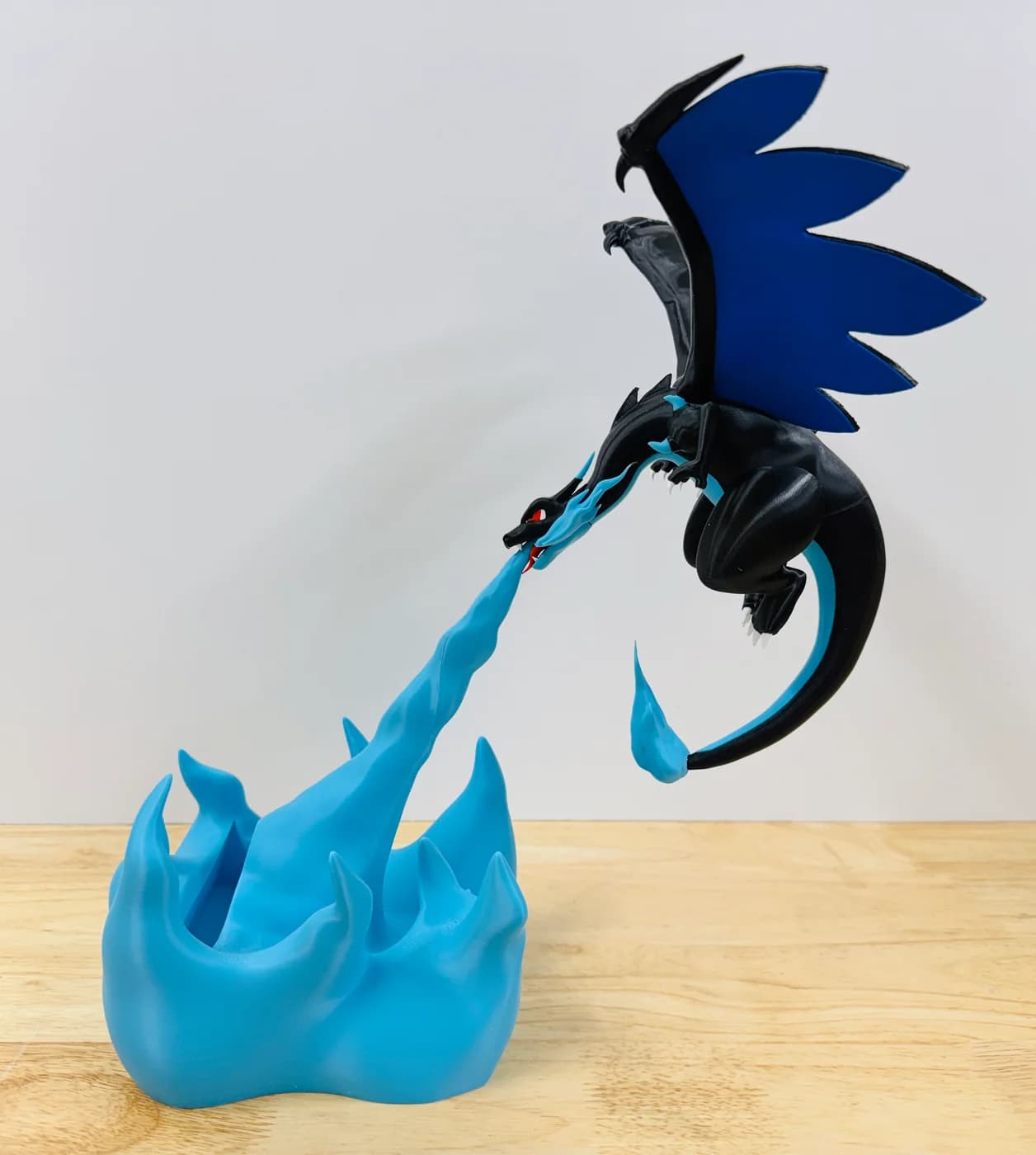
What we can help with
- Functional parts and enclosures
- Custom prototypes and product development
- Multi-part assemblies and small batch production
- File preparation and print optimization
The practical version
We print functional parts rather than ornaments: the bracket that holds a thing up, the enclosure a circuit board lives in, the discontinued knob nobody sells any more. Send us an STL and we will tell you whether it will print well, and say so plainly if another process would serve you better.
Processes, materials or platforms
- 3D Print
Ready with a file?
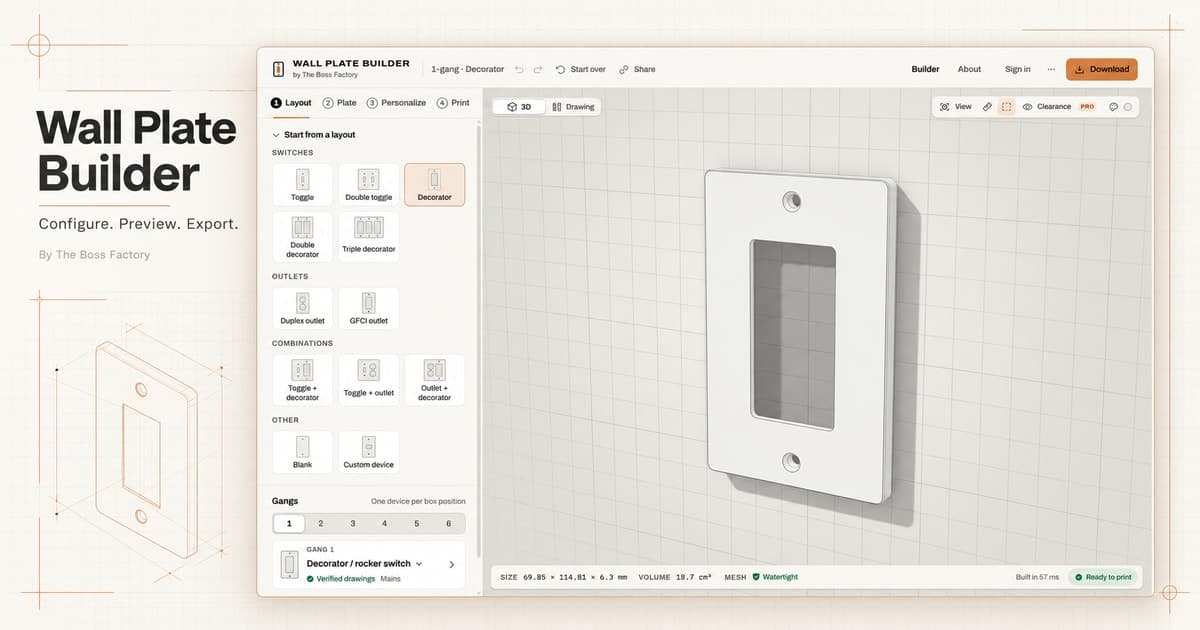
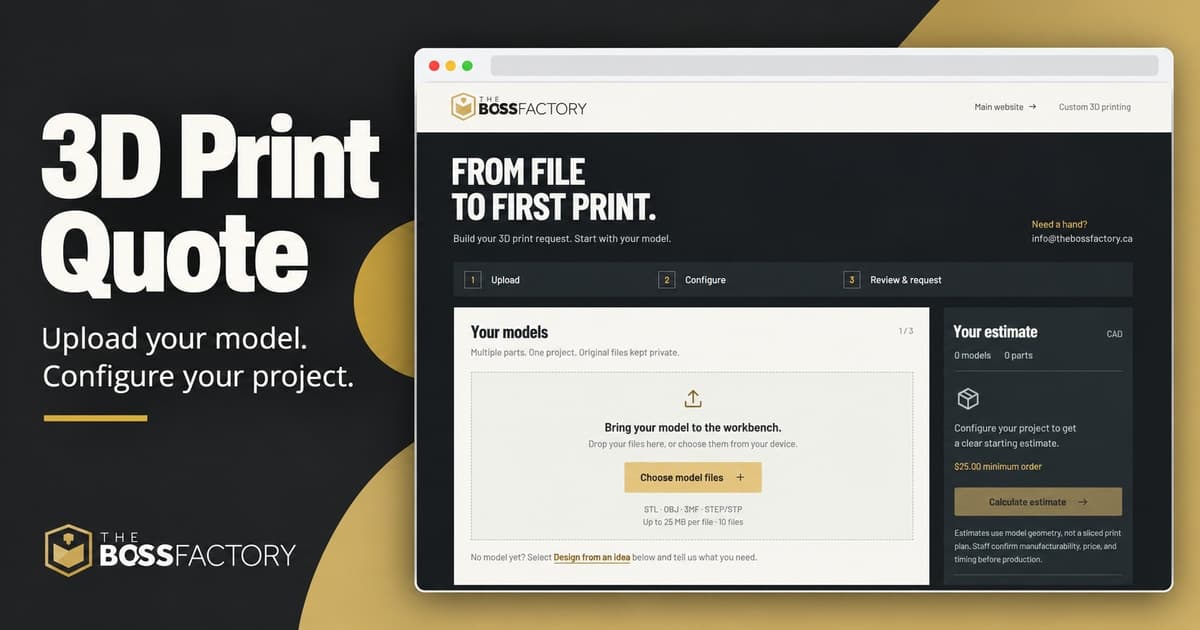
Upload an STL or OBJ and our quote tool measures the model itself. It is the fastest way to get a real number rather than a guess, and it is open to anyone.
Planning guide
What to know before you order
What FDM printing is genuinely good at
Fused-deposition printing builds a part by laying molten plastic down in layers. That process is unbeatable for one thing: producing a single physical object, in a shape nobody mass-produces, without paying for a mould or a fixture first. One part costs roughly the same per unit as the tenth.
It suits brackets, housings, enclosures, spacers, jigs and fixtures, drill guides, replacement parts for equipment whose manufacturer has moved on, and prototypes you need in your hand before committing to a production run. Anything where the geometry matters more than the surface finish is a good candidate.
It is also the right way to test a design cheaply. Printing three revisions of a part over a week costs very little and tells you things a screen never will — whether it actually clears the bolt head, whether the wall is stiff enough, whether your hand fits.
Choosing a material
Most disappointing prints are a material choice, not a printing failure. The part came out exactly as instructed, in a plastic that was wrong for where it ended up. The properties below are properties of the plastics themselves, not a stock list — tell us the environment the part lives in and we will match it.
The single most common mistake is PLA in a hot place. PLA begins to soften around 60 °C, and the inside of a car parked in July comfortably exceeds that. A PLA phone mount on a dashboard will droop, and it will look like the print failed when the print was fine.
Designing a part that prints well
A printed part is not an injection-moulded part and does not want the same geometry. A few habits account for most of the difference between a part that works and one that snaps.
The most important is orientation. A printed part is strong in the plane of its layers and weak between them — the layer bond is the weak axis. A hook printed flat on the bed will take a heavy pull; the identical hook printed standing up can peel apart along a layer line. Tell us how the part gets loaded and we will orient it accordingly, which costs nothing and is often the whole difference.
Sending us a file, or not having one
If you have a model, our quote tool takes STL and OBJ and measures the geometry directly. Export in millimetres, make sure the mesh is closed, and check the scale before you send it — a model that arrives at 1/25th size because it was exported in inches is the single most common problem we see, and it is invisible until someone looks at the dimensions.
If you do not have a model, that is normal and not a problem. A sketch on paper with a few measurements, a photo of the broken part beside a ruler, or the part itself is enough to start. Drawing the model is part of the job, and it is quoted as design time rather than hidden in the print price.
Either way a proof goes out for approval before anything is printed, so you see what we understood before plastic gets committed.
Local, and why that matters for prototypes
Prototyping is iterative, and iteration is where distance hurts. Ordering a part from an online service means every revision costs you shipping in both directions and several days of waiting. Locally you can look at the first attempt, say "the flange needs to be 3 mm thicker", and have the next one without a courier involved.
Local pickup is available in Dieppe, a few minutes from Moncton. The shop is appointment-only, so arrange a time rather than dropping in. If collecting is inconvenient we can ship, and the cost is quoted with the job.
What to send
Accepted formats: .stl, .obj
- Export in millimetres. A model exported in inches arrives at roughly 1/25th scale and the mistake is invisible until someone checks the dimensions.
- The mesh should be closed — no holes or loose faces. A model that looks fine on screen can still be unprintable if the geometry is not watertight.
- Send the source file too if you have one (STEP, F3D or similar). Editing a mesh is far harder than editing the model it came from, so if a dimension needs changing the original saves real time.
- No file at all is fine. A dimensioned sketch, or a photo of the part next to a ruler, is enough to quote design work from.
Material choices
These are general properties of each plastic, not a list of what is on the shelf. Tell us what the part has to survive — heat, sunlight, load, flex — and we will confirm what suits it and what we can run.
| Material | Good for | Trade-off |
|---|---|---|
| PLA | Indoor parts, prototypes, display pieces, anything where cost and crisp detail matter more than toughness. | Softens from around 60 °C, so it is wrong for a car interior, a window sill in direct sun, or anything near heat. Degrades outdoors under UV. |
| PETG | The sensible default for parts that have to work — brackets, enclosures, outdoor fittings. Tougher than PLA and handles roughly 80 °C. | Prints stringier than PLA so fine detail is slightly softer, and it is more prone to leaving wisps that need cleaning up. |
| ABS / ASA | Higher heat resistance, around 100 °C, and ASA in particular holds up under sustained sunlight far better than the alternatives. | Warps as it cools and really wants an enclosed printer. Large flat parts are the hardest thing to print in it. |
| TPU (flexible) | Gaskets, bumpers, feet, grips, protective sleeves — anywhere the part needs to flex or damp a shock. | Prints slowly and does not hold a precise dimension as well as a rigid plastic, so it is a poor choice for a tight mechanical fit. |
| Polycarbonate and carbon-fibre-filled blends | Stiff, dimensionally stable parts, and the higher end of what FDM will do for heat and load. | Harder to print and fussy about moisture. Carbon-filled filament is abrasive and chews through a standard brass nozzle, so it needs a hardened one. |
Design guidance
Make walls a multiple of the nozzle widthThe printer draws walls in whole extrusion widths. On a 0.4 mm nozzle that means 0.8, 1.2 or 1.6 mm walls print cleanly, while 1.0 mm leaves the slicer to fudge a gap. Anything thinner than the nozzle cannot be printed at all.
Keep overhangs within about 45° of verticalEach layer needs enough of the layer below to sit on. Past roughly 45° the plastic has nothing to bond to and droops, so the area needs support material — which prints fine but leaves a rougher surface where it was removed. A chamfer instead of a sharp overhang often avoids supports entirely.
Expect holes to come out undersizedOn a curved inner wall the extrusion overlaps slightly into the hole, so a printed hole is reliably a little tighter than modelled. For anything that needs to fit a shaft or a bolt properly, we either oversize it in the model or drill it to size afterwards.
Design the clearance you actually wantTwo parts modelled to touch exactly will not assemble. A snug press fit wants a small gap and a freely moving fit wants a larger one; the exact figures depend on the machine and material, which is why we tune them rather than quoting one number for every job.
Orient for the load, not for the pictureLayer bonds are the weak axis. The same part can be several times stronger simply printed in a different orientation, so tell us where the force comes from.
Use heat-set inserts for threads that get undoneA thread printed directly into plastic will strip after a few cycles. A brass heat-set insert melted into a boss gives a metal thread that survives repeated assembly, and it costs almost nothing to design in from the start.
When this may not be the right fit
- A flat panel, sign or plate is faster, stronger and cheaper cut on the CNC or the laser than printed. If the part is essentially two-dimensional, printing it is the wrong process.
- Parts carrying real structural load or sustained high temperature are usually a machining job in metal, and we will say so rather than sell you a plastic version that fails later.
- A thousand identical small parts wants injection moulding. Printing is priced per part, so somewhere in the low hundreds the economics stop favouring it — we will tell you when you cross that line.
- If the thing exists off the shelf for a few dollars, buy it. Re-creating a stock bushing or a standard bracket costs more in design time than the part is worth.
- Very large single pieces have a size limit. Past a certain point a part has to be printed in sections and joined, which is often fine — but it is a design decision worth making deliberately, not a surprise.
Common questions
Can you print a file I already have?
Yes. Upload an STL or OBJ to our quote tool at quote.thebossfactory.ca and it measures the model directly, or email it to info@thebossfactory.ca. We will tell you if anything about the geometry will cause trouble before we print it.
What does a print cost?
It depends on the size of the part, how much plastic it uses and how long the machine runs, so we quote from the actual file rather than a price list. The quote tool gives you a real number from your own model in about a minute.
I do not have a 3D model — can you still help?
Yes, and this is common. Bring a sketch with a few measurements, a photo of the broken part beside a ruler, or the part itself. Drawing the model is quoted as design time and you own the result.
How long does it take?
Production is 5-7 business days once the design is settled, and the design is not settled until you have approved the proof. If you are working to a deadline, tell us the date up front and we will tell you honestly whether it is achievable.
Which material should I choose?
Tell us where the part lives instead. Heat, sunlight, load and whether it needs to flex decide the material, and those are questions about your situation rather than about plastic. The most common mistake is PLA somewhere hot — it softens around 60 °C, which a parked car exceeds easily.
Do you do 3D printing in Moncton, or only Dieppe?
The shop is in Dieppe, a few minutes from Moncton, and serves Greater Moncton and the surrounding area. Local pickup is in Dieppe by appointment. If shipping is easier, the cost is quoted with the job.
Is 3D printing always the right way to make a part?
No, and we would rather say so. Flat panels belong on the CNC or the laser, high-load or high-temperature parts are often a machining job, and large quantities eventually favour injection moulding. If your part is one of those we will point you at the better process.
Start with the result, not the process.
Send whatever you have—a sketch, dimensions, reference photo or a simple description.