
- relay vs ssr
- solid state relay
- mechanical relay
- motor control
- heater control
Solid State Relay vs Mechanical Relay: Pick by Load
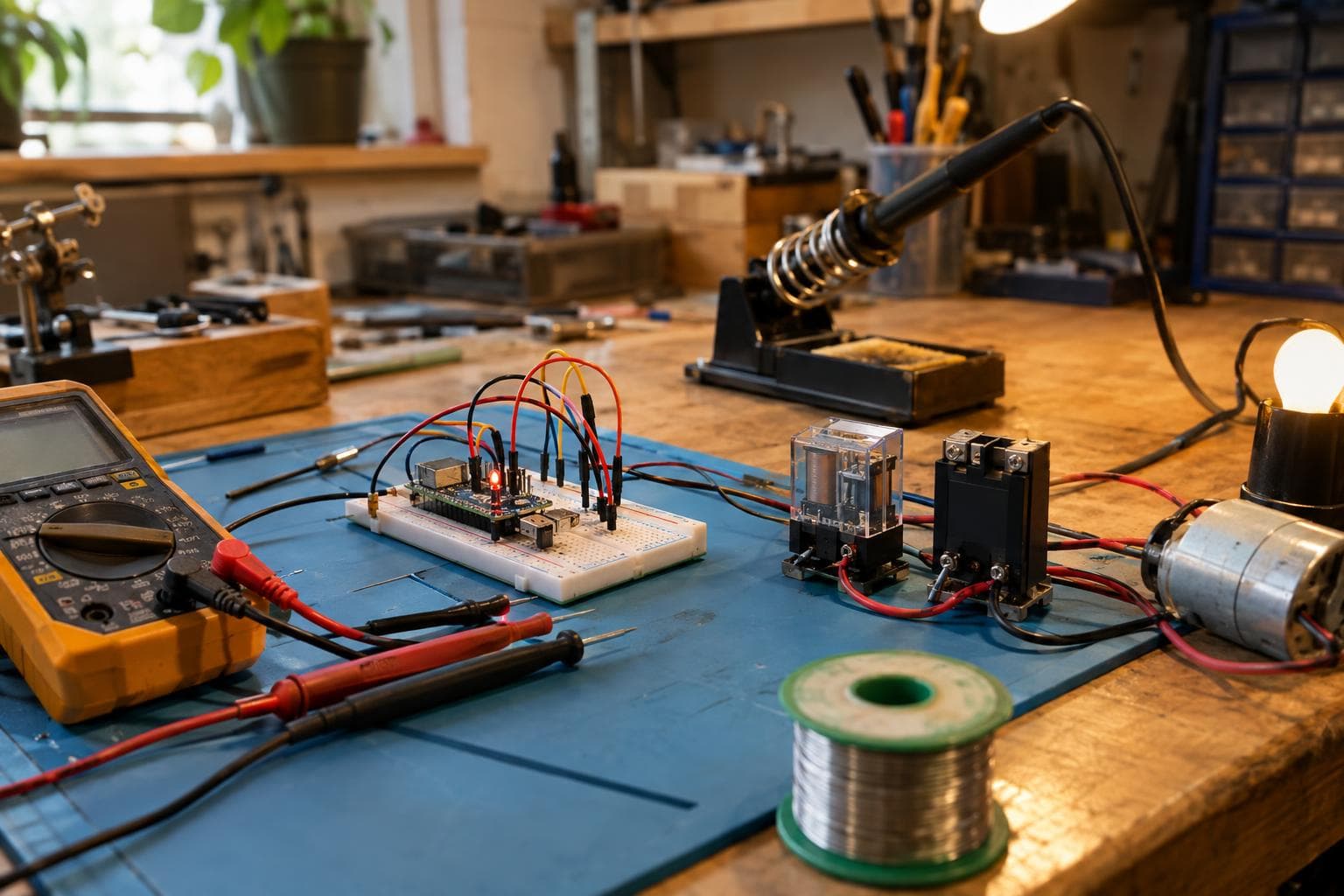
The relay vs SSR decision is not mainly about which part is newer. It is about what the load does to the switch, how often it switches, and what happens in the off state. For a heater, a solid state relay is usually the right tool; for a small motor or simple lamp, a mechanical relay is often the cheaper and cleaner choice.
Mechanical relay vs solid state relay: the useful differences
A mechanical relay moves contacts with a coil. A solid state relay uses semiconductors, commonly a triac or SCR pair for AC loads and MOSFETs for DC loads.
| Technical axis | Mechanical relay | Solid state relay | What decides the job |
|---|---|---|---|
| Contact life | Finite mechanical contact life; affected by load current, voltage, arcing, and switching frequency | No contacts to wear; semiconductor life is mainly limited by heat, surge, and electrical stress | Frequent switching favours SSR, but only if its heat and surge ratings fit |
| Switching speed | Usually slower, with coil pickup and release time measured in milliseconds | Generally faster; exact timing depends on the relay circuit and zero-cross or random-fire design | Fast control, dimming, or pulse timing needs the specific SSR datasheet |
| Leakage when off | Normally extremely low across open contacts | Small off-state current is normal | High-impedance LED lamps and inputs can respond to SSR leakage |
| Heat while on | Contacts usually have low resistance; the coil still consumes power | Semiconductor voltage drop produces heat in the load current path | Higher-current SSRs often need a heatsink |
| Inductive loads | Contacts can arc; suppression is required | Turn-off, commutation, dv/dt, and inrush depend on the semiconductor type | Motors need a relay rated for motor duty or an SSR made for that motor and supply |
| Fault tendency | Contacts can weld closed or fail to conduct | Semiconductors commonly fail shorted after excessive heat or surge | A safety design must account for either failure mode |
| Cost per part | Often lower for a basic, low-cycle switch | Often higher at low current, with possible heatsink and thermal hardware | The cheaper part is the one that does not need extra suppression or cooling |
The table is a design filter, not a substitute for the part's datasheet. A relay marked for a certain resistive current may have a much lower motor or lamp rating. An SSR's headline current rating may assume a particular heatsink, ambient temperature, mounting method, and duty cycle.
Switching speed and contact life
A mechanical relay needs time for its coil to build a magnetic field and move the armature. It also bounces briefly as the contacts close. That is irrelevant for a thermostat changing state every few minutes, but it matters for pulse trains and fast interlocks.
A solid state relay has no contact bounce and usually switches faster. Do not treat every SSR as an instant switch. AC SSRs are commonly sold in zero-cross and random-fire versions. A zero-cross device waits for the AC waveform to approach zero before turning on, which reduces electrical noise and inrush stress. It is unsuitable for some phase-control or precise timing jobs. A random-fire device can turn on at another point in the waveform, but that can create more interference and stress.
Mechanical contact life is also load-specific. Opening a small resistive load is gentle. Opening an inductive load, a transformer, or a motor creates a voltage spike that can arc across the contacts. The relay may survive many low-stress operations and a much smaller number of high-stress operations. A flyback diode belongs across a DC coil, while an RC snubber or a suitable clamp may be needed for AC or other inductive loads. The suppression part must match the load and switching direction.
An SSR removes mechanical wear, but it does not remove failure. Heat cycling, load surges, excessive dv/dt, and a shorted output device can end its life. Many SSRs fail shorted, leaving the load on. That is a worse failure than a light that refuses to turn on, so a safety-critical circuit needs an independent disconnect or fault response.
Off-state leakage and on-state heat
Two SSR properties cause most bench surprises.
First, a solid state relay leaks a small current when off. The current is usually tiny compared with the load's operating current, but it is not zero. A high-efficiency LED lamp can glow faintly instead of going fully dark, or an electronic power supply can keep trying to start. The exact leakage belongs to the SSR datasheet and varies by output type and voltage.
A mechanical relay's open contacts normally block that current almost completely. For a lamp that must be visibly dark, that difference can matter more than switching speed. A properly selected bleeder resistor, a compatible bypass device, or a different switching method can deal with SSR leakage, but each adds its own power and safety considerations. Do not add a resistor across mains without calculating its voltage, dissipation, enclosure, and fault behaviour.
Second, a solid state relay drops voltage while conducting and therefore needs a heatsink at higher currents. The output voltage drop multiplied by load current becomes heat inside the SSR. The required thermal path depends on the relay's output technology, current, ambient temperature, mounting surface, and duty cycle. Use the manufacturer's thermal data rather than choosing a heatsink from the nominal current label.
A mechanical relay generally has much less voltage drop across closed contacts, though its coil consumes power and can warm the enclosure. For a low-duty load, that makes the mechanical option attractive. For a heater running for hours, the SSR's output heat must be included in the enclosure design, while the mechanical relay's contact wear and switching frequency may be the larger concern.
Which switch suits a lamp, motor, or heater
Lamp
For an incandescent lamp switched occasionally, we would normally pick a mechanical relay if its voltage and inrush ratings are suitable. The off state is clean, contact resistance is low, and no heatsink is needed.
An LED lamp needs more care. Its internal power supply may draw a sharp startup current, and SSR leakage can make it glow faintly when off. A mechanical relay is often the straightforward choice for one lamp or a small bank of lamps. An AC SSR can work if its leakage, minimum load behaviour, inrush rating, and zero-cross timing are all compatible. The lamp label alone does not provide enough information to select the relay.
Motor
For a small motor that starts occasionally, we would usually choose a mechanical relay with a motor-rated contact specification and suppression suited to the motor. The contact rating must account for startup current, not just the running current. A relay that looks adequate on a resistive load can weld or arc badly on a motor.
An SSR is not automatically quieter or safer for a motor. An AC triac SSR may have trouble turning off if the motor current falls below its holding current, and it can be stressed by startup surges. A DC motor needs a DC-rated SSR, normally with MOSFET output, and a path for inductive energy. A motor-specific solid state controller may be a better circuit than either general-purpose relay type when speed control or frequent reversing is required.
Heater
For a resistive heater that cycles often, we would pick a solid state relay, usually an AC zero-cross type for ordinary on-off temperature control. It avoids contact wear and is quiet. The SSR still needs correct fusing, voltage rating, load-current margin, enclosure airflow, and a heatsink sized from its thermal data.
For a small heater that runs rarely, a mechanical relay is good enough. Replacing a relay that switches a few times per hour with an SSR does not improve the result if the real issue is poor temperature sensing, inadequate hysteresis, or a missing fuse. The SSR's purchase price and heatsink do not buy useful performance in that case.
How the decision changes with use and quantity
Unit quantity does not create a universal crossover. A one-off controller can use a mechanical relay, and a thousand-unit product may still use one if the load switches rarely and the relay's life calculation passes. Conversely, one frequently cycled heater can justify an SSR even in a single prototype.
Use this order of checks:
- Identify AC or DC output first. An AC triac SSR is not a substitute for a DC MOSFET SSR.
- Record running current, startup or inrush current, voltage, and the load's power factor.
- Decide how often the output changes state and how long it stays on.
- Check off-state leakage against the load, especially with LED lamps and electronic power supplies.
- Check the SSR's on-state voltage drop and calculate heat at the actual current.
- Add suppression for coils and motors, then verify that the suppressor does not interfere with release or turn-off.
- Decide how the circuit should fail: off, on, or disconnected by a separate safety device.
The answer flips at duty cycle, not at a part count. Pick the mechanical relay when low leakage, low on-state heat, and occasional switching matter most. Pick the solid state relay when frequent switching and silent operation matter more, and the design has room for its leakage and heat.
Frequently asked questions
Will an SSR turn an LED lamp completely off?
Not always. A solid state relay leaks a small current when off, and some LED lamps respond by glowing faintly or pulsing. Check the SSR's specified leakage current and the lamp's input circuit. A mechanical relay usually gives a cleaner off state.
Does every solid state relay need a heatsink?
No. The need depends on output type, current, voltage drop, ambient temperature, duty cycle, and the relay's thermal specification. At higher currents, the voltage drop while conducting creates enough heat that a heatsink is required. Calculate the dissipation instead of relying on the label's maximum current.
Is a solid state relay better for a motor?
Not by default. A motor's inrush, inductive turn-off behaviour, supply type, and required switching pattern decide the choice. A correctly rated mechanical relay is often the simpler option for occasional starts; a suitable DC or AC SSR can be better for frequent switching if its thermal and commutation limits are met.
We build relay and solid-state control projects to order through custom electronics and smart systems.
Related services
All services →
Have a project in mind?
Tell us what you want built — we reply within 24–48 hours.