
- filament storage
- summer humidity
- basement humidity
- 3d printing
- moisture control
Summer Humidity Filament Storage: Fix Wet Spools
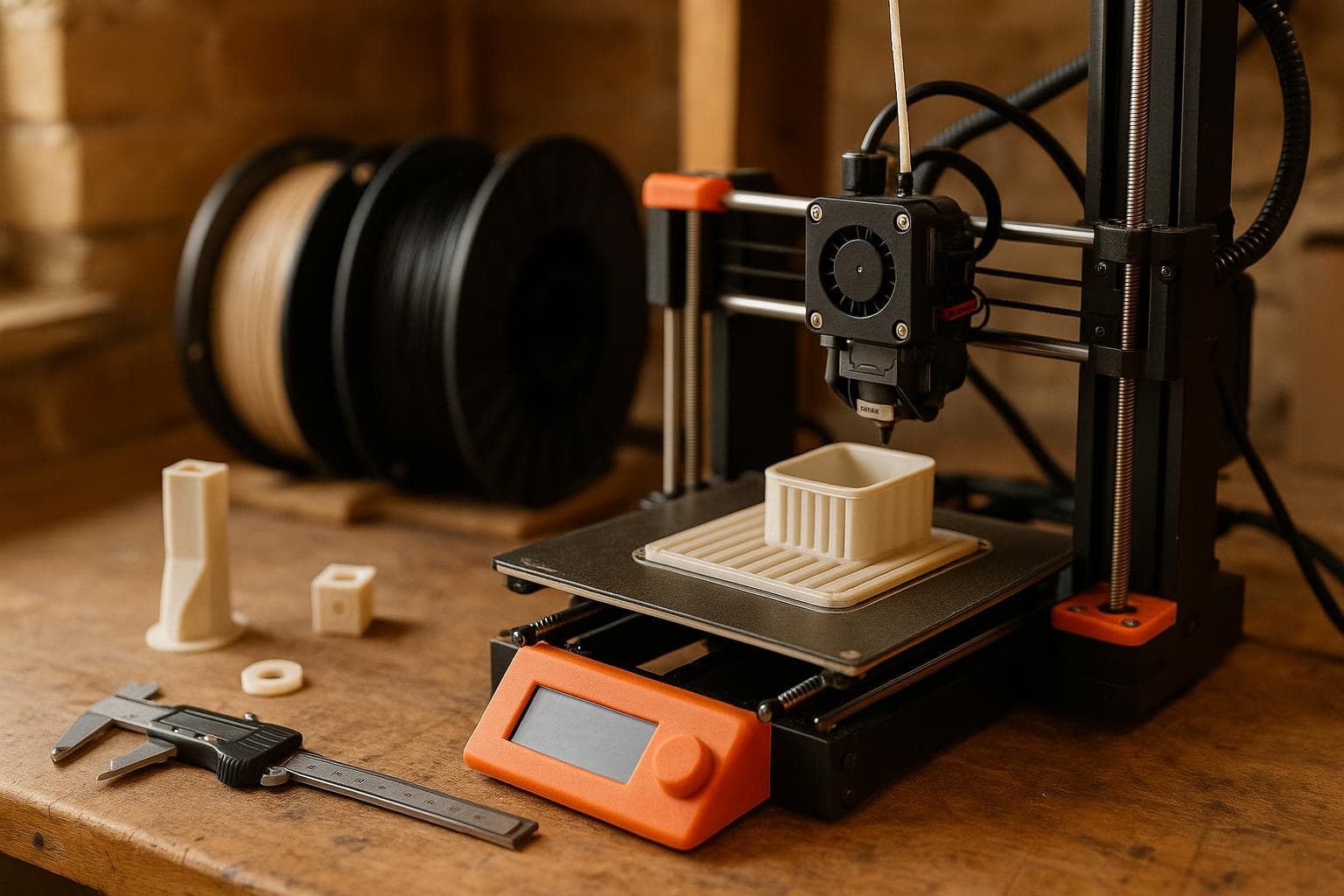
A spool that prints with popping, stringing, cloudy surfaces, or inconsistent extrusion may not have a printer problem at all. Start with storage: a basement in high summer can load filament with moisture faster than a comfortable room suggests, and a sealed box only works if its seal and desiccant are doing their jobs.
Why summer makes a basement bad filament storage
Warm air holds far more moisture than cool air. That does not mean a cool basement is dry. Humid outdoor air enters through doors, windows, cracks, and ventilation, then reaches a space whose temperature may feel comfortable while its relative humidity remains high. As air cools against concrete walls or floors, its relative humidity rises further, and damp surfaces can keep the room humid even without visible condensation.
This makes high summer the worst storage period of the year in many basements. Winter air is often cold and dry before it enters the building. Summer air arrives carrying much more water vapor, and a basement can hold that moisture around open spools for weeks.
The first seasonal change we would make is cheap: stop treating the printer area as filament storage. Keep working spools in a sealed container whenever they are not feeding the machine. Put the container away from a concrete floor or exterior wall, add a hygrometer, and check it after several hours rather than judging the room by feel.
A hygrometer reading is useful for spotting change, not for proving that filament is dry. The air inside a container can be dry while the polymer still contains absorbed water. It tells you whether the container is controlling its environment, which is the first question to answer.
Check the open spool and the room first
The most likely cause is exposure time. PLA can show moisture symptoms after poor storage, while nylon, TPU, and many PETG formulations generally demand more care because they absorb water more readily. The exact behavior depends on the polymer, additives, spool history, and printer settings.
Test this before changing hardware:
- Put a fresh, unopened spool of the same material on the printer.
- Keep nozzle temperature, speed, retraction, and cooling unchanged.
- Print a small part with walls, travel moves, and a top surface so several symptoms are visible.
- Compare popping at the nozzle, hairs between features, surface roughness, and extrusion consistency.
If the fresh spool prints normally, storage or moisture is the leading suspect. If both spools behave the same way, check nozzle condition, heat stability, feed-path drag, and settings before blaming humidity.
A spool left open through a humid season can need many hours of drying to recover. Do not assume a short warm-up has removed moisture from the center of the winding. Follow the filament manufacturer's drying temperature and time for that material, and make sure the dryer actually reaches the stated temperature at the spool rather than only at its empty chamber.
Do not raise the temperature because a different polymer dries faster. A spool can deform, fuse against itself, or soften around the hub, and some materials have additives that change their safe drying range. If the manufacturer's guidance is missing, identify the exact polymer and consult its technical data before choosing a cycle.
Find the storage failure before replacing parts
Once a dry spool confirms the diagnosis, inspect storage from cheapest failure to more involved failure.
1. The container is not sealed
A loose lid, pinched gasket, damaged zipper, or filament feed-through can exchange air continuously. This is common with boxes that seem closed but were never designed to hold a dry atmosphere.
Test it by putting the hygrometer inside with fresh desiccant, closing the container, and recording the humidity over the next day. Open the container once, then close it again and watch how quickly the reading climbs. A rapid return toward basement humidity points to leakage, not insufficient desiccant.
For a feed-through, leave the filament path empty and temporarily seal the opening. If the humidity stabilizes, the path needs a tighter plug or a less exposed arrangement. The cheap plastic tote may be good enough here if its lid seals well. Do not buy an active dry box to compensate for a lid that leaks around the edge.
2. The desiccant is exhausted
Desiccant does not dry a wet spool instantly. It absorbs moisture from the air inside the container, and its capacity is finite. Opening the lid repeatedly during summer can consume that capacity faster than expected.
Test the desiccant separately from the spool. Use fresh or correctly regenerated desiccant in a sealed empty container and watch the humidity trend. If the container reaches a low, stable reading, the seal is probably adequate. If the reading stays high, revisit the seal before adding more packets.
Regenerate reusable desiccant only according to its material instructions. Some products tolerate oven heat, while others have indicators, binders, or containers that do not. Replace disposable packets once they are spent. A larger packet is not a cure for a leaking box.
3. The spool is already wet
A dry container prevents further uptake; it does not pull water out of polymer quickly enough to replace a proper drying cycle. This is where many storage setups get misdiagnosed. The hygrometer can show a dry box while the spool still prints badly.
Test by drying the spool according to its material guidance, then printing the same small test again from the same setup. Listen for nozzle pops and watch the walls. Moisture can flash into steam at the nozzle, causing bubbles, uneven flow, stringing, and rough surfaces. A dry spool that still fails the test sends you back to the printer, not to stronger desiccant.
Choose a seasonal storage method
The right arrangement depends on how often the spool is used and how sensitive the material is. Our default choice for hobby printing is a sealed tote or dry box with a gasket, a hygrometer, and replaceable desiccant. It is inexpensive, quiet, and adequate for PLA and many short-term jobs when the seal is sound.
| Storage method | Temperature control | Moisture control | Main failure mode | Best use |
|---|---|---|---|---|
| Open shelf | Room temperature only | None | Spool absorbs basement humidity | Same-day use in a genuinely dry room |
| Sealed tote with desiccant | Room temperature | Passive, depends on seal and desiccant capacity | Leaks or exhausted desiccant go unnoticed | Most hobby storage and seasonal rotation |
| Heated dry box while printing | Controlled within the unit's stated range | Active drying during use | Wrong material setting, poor temperature uniformity, or empty desiccant | Moisture-sensitive filament or long prints |
| Dedicated dryer, then sealed storage | Controlled drying cycle | Drying first, passive storage afterward | Inadequate cycle or re-exposure after drying | Recovering a wet spool |
An active heated box is useful when a material must stay warm and dry during a long print, especially if the spool is sensitive and the room is humid. It is not automatically better for every spool. For ordinary PLA kept in a properly sealed container, the upgrade may solve a problem you do not have while adding heat, power use, and another temperature setting to verify.
Seasonally, we would change the routine rather than buy first. In spring, inspect gaskets and replace damaged seals. Before summer, regenerate or replace desiccant and check the empty container. During the humid months, return every unused spool to storage after printing. In winter, still use the container, but expect fewer problems from room air in many climates.
Confirm the printer is not the real cause
Humidity is an attractive diagnosis because the symptoms are distinctive, but it is not exclusive. Wet filament usually produces audible popping, tiny voids, fuzzy surfaces, or unstable extrusion. A worn drive gear, partial nozzle blockage, excessive retraction, a loose spool path, or a temperature mismatch can create similar defects.
Use a controlled comparison:
- Print the same test with the suspect spool.
- Dry that spool using the manufacturer's instructions.
- Print it again without changing slicer or hardware settings.
- If possible, compare a new spool of the same material and color.
If drying changes the result, storage was part of the cause. If it does not, inspect the nozzle and feed system, then tune temperature and retraction with a known-dry spool. Do not compensate for wet material by raising nozzle temperature or increasing retraction. Those changes can hide one symptom while creating another.
Keep a small record of material type, drying cycle, storage humidity, and print result. The useful comparison is not a universal humidity number. It is the condition under which your material, spool, and printer produce a clean test.
Frequently asked questions
Can filament stay in a sealed bag all summer?
Yes, if the bag seals well and contains enough active desiccant for the air volume and opening frequency. A thin storage bag with a weak closure is not equivalent to an airtight container. Check the humidity after sealing, and dry the spool first if it has already spent weeks exposed.
How long should wet filament be dried?
There is no safe universal time. It depends on polymer, spool size, moisture level, dryer temperature, and heat transfer. A spool left open through a humid season can need many hours. Use the manufacturer's cycle, then confirm the result with a repeat print rather than relying only on the timer.
Is a basement too humid for filament storage?
Not necessarily, but an open shelf is a poor bet during high summer. Measure the storage container, not just the room, and keep the spool sealed with fresh desiccant. If the container cannot hold a dry reading, fix its seal before buying a heater.
The Boss Factory builds this kind of work to order through the quote page, covering 3D printing, design, and custom projects.
Related services
All services →
Have a project in mind?
Tell us what you want built — we reply within 24–48 hours.