
- surge protection
- lightning safety
- electronics
- maker safety
- storm season
Surge Protection: What Actually Saves Electronics
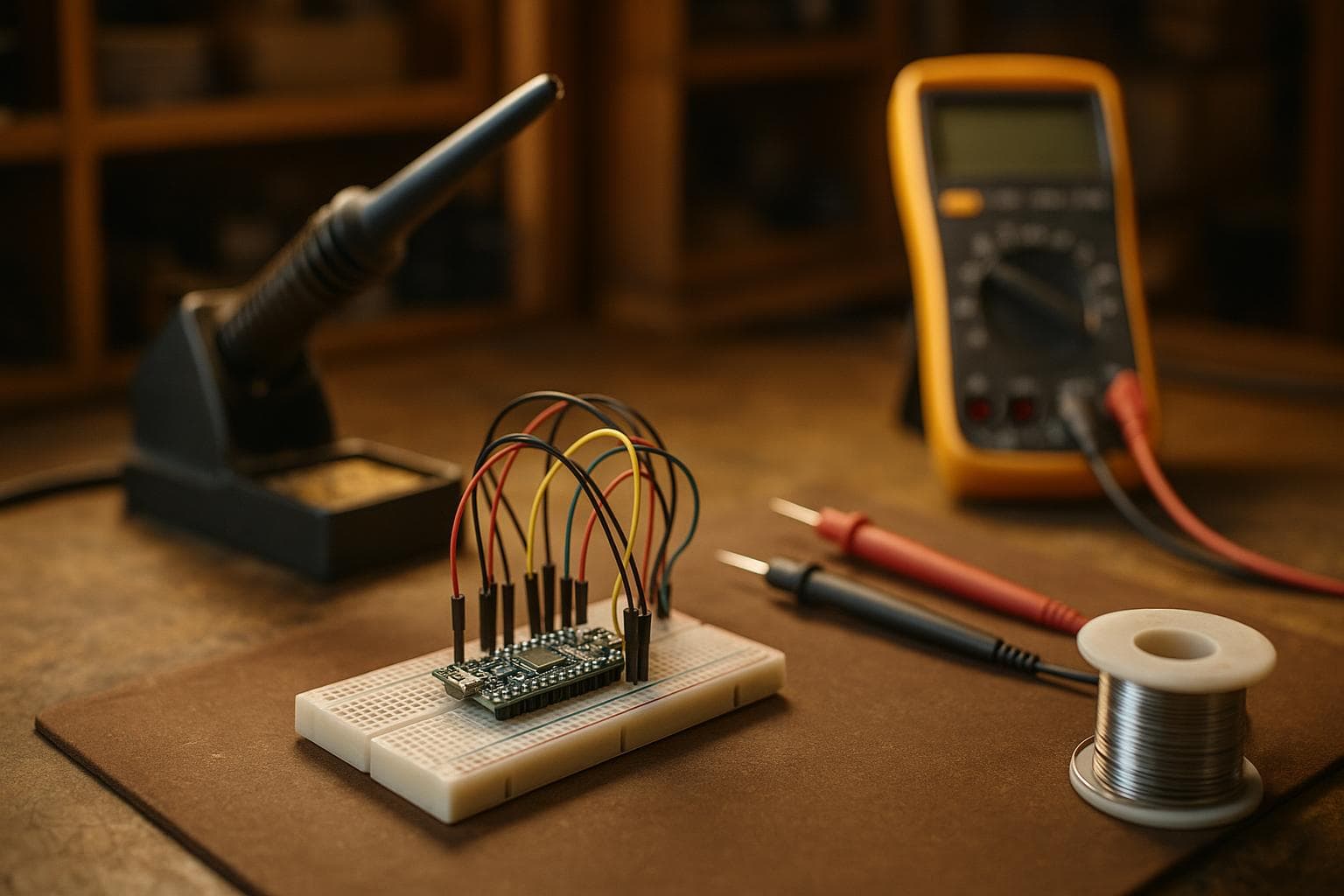
A power strip with a surge label is not a permanent shield, and it cannot protect a device through every cable entering its enclosure. The short answer is to clamp or divert ordinary transients, protect every conductive path, and physically disconnect equipment when a nearby strike is possible.
What a surge protector actually does
Most plug-in surge protectors use metal-oxide varistors, or MOVs, between line and neutral, line and protective earth, and sometimes neutral and protective earth. At normal mains voltage, an MOV conducts very little. A voltage spike pushes it into conduction, diverting current and limiting the voltage that reaches the load.
That action has a cost. An MOV degrades with every event it absorbs. A small transient may use very little of its life; a larger event can damage it internally. Repeated smaller events also add up. The protector may eventually stop clamping while still passing mains power, so the connected equipment appears to work normally until the next surge causes damage.
The indicator light on a strip is useful only if you understand what it monitors. It may show that a protection component is connected, but it is not a measurement of remaining protection capacity unless the manufacturer says that is what the circuit detects. A dark indicator means replacement is due. A lit indicator does not prove that the unit can absorb another event.
Read the manufacturer’s data sheet rather than the marketing label. The useful figures include:
- MCOV, the maximum continuous operating voltage the MOV is intended to withstand.
- VPR, or voltage protection rating, measured under the test conditions specified by the applicable standard.
- Nominal discharge current, often shown as a kiloampere value and tied to a defined test waveform.
- Short-circuit and thermal protection, which determine how the device fails if an MOV overheats.
- UL 1449 or IEC 61643-11 compliance, depending on the certification system used for that SPD.
A larger kA figure does not automatically mean a lower voltage reaches your circuit. VPR, clamping arrangement, wiring length, and installation all matter. A long lead between the protector and the equipment adds inductive voltage during a fast event, so keep the connection short and use the wiring arrangement specified by the manufacturer.
The vulnerable circuit has two paths
A controller, network switch, CNC control, audio interface, or computer can be connected to mains through its power supply and to a long conductive cable through its data, antenna, sensor, or communications port. A surge does not need to arrive through the wall outlet to cause lightning damage electronics.
The damaging mechanism is voltage difference. Suppose a surge raises the potential of a long outdoor cable while the equipment chassis remains closer to the mains reference, or the reverse. The difference appears across the input protection components, cable shield, signal ground, transformer isolation barrier, or the silicon inside the interface. Current then finds a path between the two systems. The cable may carry only a low-voltage signal during normal operation; during a surge, its length and connection to an outdoor conductor make it a substantial entry route.
This is why protecting only the AC strip is incomplete. The following paths deserve the same inspection:
- Ethernet, including PoE lines and long runs between buildings.
- Coaxial antenna, camera, radio, and cable-modem connections.
- RS-485, CAN, alarm, thermostat, and other long copper signal cables.
- USB or serial cables leaving the room or connecting separately grounded equipment.
- Sensor wiring attached to fences, roofs, gates, outside machinery, or buried runs.
A data-line protector must match the interface. Check its supported protocol, conductor count, PoE voltage and current, insertion loss, clamping voltage, and grounding method. A protector intended for ordinary Ethernet may not be suitable for a PoE supply or a high-speed link. A coaxial protector needs the correct impedance and frequency range. Installing a part because its connector fits is not enough.
Controls that work together
For a fixed installation, we prefer a coordinated system rather than one heavily rated strip at the bench. A service-entrance or panel-mounted SPD can reduce the energy entering the building. A point-of-use SPD can handle the remaining transient near sensitive equipment. Data-line protection closes the second route. The installation must follow the manufacturer’s bonding and conductor-length requirements, and panel work belongs to a qualified electrician where local rules require it.
The control with the highest confidence is physical disconnection. During a storm that may produce nearby strikes, unplug the equipment from mains and disconnect copper data and antenna cables at the equipment end, with enough separation that an arc cannot bridge the gap. Turning off a power strip is not equivalent to unplugging it unless the strip is specifically designed and rated to provide the needed isolation. A switched network device can still leave its cable connected to the vulnerable port.
Fiber is useful because glass does not conduct the surge between buildings. It still does not protect the equipment from a surge on its local mains supply, and copper power, control, or grounding conductors can defeat the benefit if they remain connected. Use fiber as part of a separated system, not as a magic shield around a mixed copper installation.
No consumer SPD guarantees survival of a direct strike, and a nearby strike can induce large voltages in wiring without a direct contact. A properly designed building grounding and bonding system, coordinated SPDs, short connections, and disconnection reduce risk. They do not make an exposed outdoor antenna or a long copper run invulnerable.
Pick the control for the failure you have
| Control | Mains path | Data or antenna path | Main failure mode | Best use |
|---|---|---|---|---|
| Plug-in MOV SPD | Clamps line transients at the receptacle | Usually none | MOV ages and may pass power after protection is spent | Bench equipment with short internal cables |
| Panel-mounted SPD | Diverts energy before branch circuits | None unless a separate data system is installed | Incorrect bonding, wiring, or rating reduces performance | Fixed installations with multiple branch circuits |
| Interface-specific data SPD | None | Clamps the named conductors and references them to a bonding point | Wrong protocol, impedance, PoE rating, or poor bond | Long copper Ethernet, coax, or control wiring |
| Unplugging and separating cables | Removes the mains connection | Removes the conductive signal route | Residual induced fields and nearby arcing can still cause damage | Forecast storms and equipment that can be shut down |
| Fiber link between locations | Protects the link from conducted current | No conductive path through the fiber | Local mains or metal accessories remain exposed | Separate buildings or outdoor endpoints |
We would spend money on a correctly rated data protector or a proper panel SPD before buying an expensive audiophile power conditioner. Those conditioners may solve noise problems, but noise filtering and surge survival are different jobs. If the device has no long external cable and can be unplugged before storms, a basic, certified plug-in SPD is often good enough. The upgrade to a large rack unit fixes a problem you may not have.
Build a shutdown plan at the bench
A useful plan is faster than trying to remember every cable while thunder is already overhead. Label the connections by destination, not by device name: wall power, roof antenna, outside sensor, second building, and so on. Put the removable end of each cable where it can be separated without moving the machine.
For a controller or computer, record the safe shutdown sequence before the storm. Abrupt power removal can corrupt storage or interrupt a machine in an unsafe state, so finish motion, stop heaters, save work, and then isolate the conductors. A UPS can bridge a short outage and permit an orderly shutdown, but its battery and inverter do not remove the need for surge protection on the incoming and outgoing connections.
After a significant event, inspect and test the protection rather than trusting the indicator. Look for a failed status light, heat damage, cracked housings, tripped upstream protection, unexplained link errors, intermittent sensors, or a device that resets under load. Replace an SPD after its specified end-of-life indication, after a known substantial event if the manufacturer calls for replacement, or whenever its condition is uncertain. Do not open a mains SPD to assess an MOV by eye.
The routinely underrated risks are the second cable, the cable shield, and the protector that has already spent its useful life. The most expensive component is not always the most exposed one; an isolated sensor interface or network port can fail while the mains supply still appears normal. Trace every conductive route into the enclosure, then choose a control that addresses that route.
Frequently asked questions
Does a surge protector protect Ethernet and USB cables?
Usually not. A mains-only protector acts on the conductors in its power connection. Ethernet, USB, coax, and sensor cables need interface-specific protection, and the protector must be rated for the protocol, speed, voltage, current, and grounding arrangement.
Should I replace a surge protector after every thunderstorm?
Not automatically. Follow the manufacturer’s replacement guidance and status indication. Replace it after a known damaging event when the data sheet requires that, after an end-of-life indication, or when its condition cannot be trusted. Remember that it can continue passing power after its clamping function has been consumed.
Can a whole-house surge protector stop lightning damage electronics?
It can reduce conducted transients entering through the electrical service, but it cannot guarantee survival of a direct or nearby strike. Protection is stronger when mains SPD installation, bonding, data-line protection, and physical disconnection are treated as one system.
The Boss Factory builds made-to-order custom electronics and smart home systems; request a quote.
Related services
All services →
Have a project in mind?
Tell us what you want built — we reply within 24–48 hours.