
- 3d printing
- uv degradation
- outdoor prints
- filament
- material science
UV Degradation in 3D Prints: Why Parts Turn Brittle
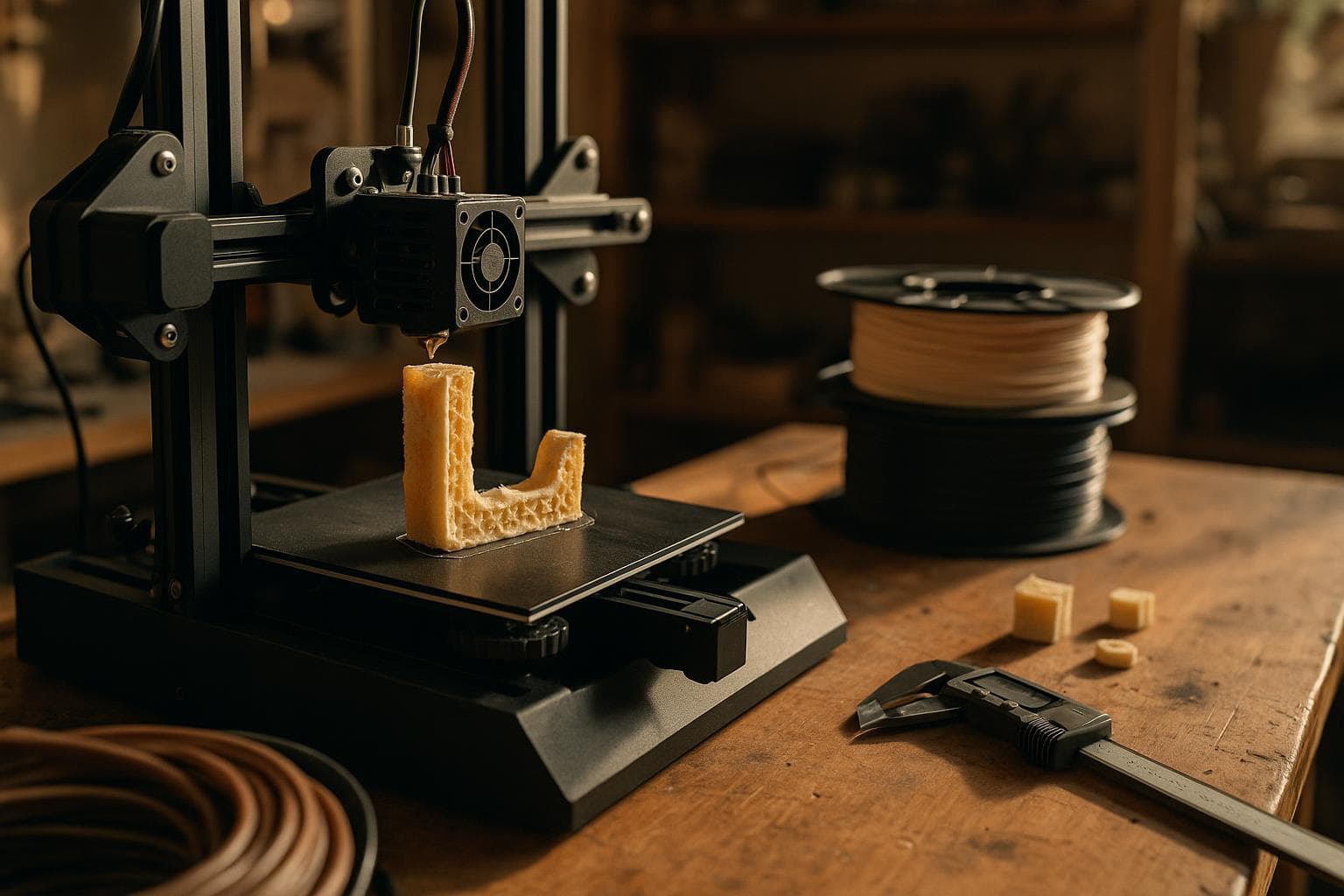
A printed part can look unchanged after months outside and still be close to failure. The honest short answer is that UV degradation plastic usually starts as a thin, damaged skin: sunlight breaks polymer chains, oxygen reacts with the damaged material, and the surface loses toughness before the part has time to visibly warp.
What sunlight does to a plastic surface
Sunlight contains ultraviolet radiation with enough energy to disrupt chemical bonds in some polymers. The exact response depends on the polymer, its additives, its colour, the wavelength reaching it, and how much oxygen is present at the surface.
A UV photon absorbed by the polymer can create an excited molecule or a free radical. That unstable site may split a chain, react with oxygen, or link two chains together. Chain scission lowers the average molecular weight and leaves the material less able to absorb impact. Crosslinking can make a surface harder while reducing its ability to stretch. Both reactions can happen in the same plastic, with one dominating according to the formulation and exposure conditions.
The surface takes the first hit because UV intensity falls as it is absorbed. A dark pigment, a UV stabilizer, or the polymer itself can stop much of the radiation before it reaches deeper layers. That is useful protection for the interior, but it also concentrates damage near the exposed face. Scratches, layer ridges, thin walls, and sharp corners can expose fresh material and create local weak points.
Oxygen makes the process worse. UV-generated radicals react with oxygen at the surface, producing oxidized fragments and more radicals. Heat speeds many of these reactions, so a dark part sitting in direct sun can age faster than the same part under cool, indirect light even if both receive similar UV exposure.
Why chalking and cracking come before shape change
Chalking is often the first visible warning. The degraded surface becomes rough and can shed small particles. Oxidized fragments, broken chains, exposed filler or pigment, and tiny cracks scatter light in many directions, giving the part a pale, dusty appearance. A part may look faded before it looks deformed because colour and surface texture respond to a very thin damaged layer.
Brittleness follows the same order. The outer skin loses elongation and impact resistance, so a tab that used to flex now snaps, and a screw boss cracks when the fastener is tightened. The part's overall dimensions may remain close to the original because most of its volume is still intact.
Shape change needs a different failure path. It usually requires heat, sustained load, moisture, loss of layer adhesion, or enough material degradation through the wall to reduce stiffness. A sun-exposed bracket can therefore fail under load while its calipers still show the expected dimensions. Dimensional inspection alone is a poor outdoor-life test.
Layered prints add another complication. UV does not attack every layer equally. The exposed perimeter and upper surfaces receive more radiation, while internal material and enclosed faces may remain protected. A crack can start at a weathered outer corner, then run along a layer boundary because that path offers less resistance than cutting through a sound section.
For a loaded part, we inspect the failure mode rather than waiting for visible deformation. Useful warning signs include:
- A dusty residue that returns after wiping
- Fading or a change from glossy to dull texture
- Hairline cracks around holes, threads, and sharp corners
- Snapping instead of bending when a sacrificial test tab is flexed
- Cracks that begin on the sun-facing side
- A surface that feels rougher or harder than a protected sample
Do not flex a critical part as a test. Make a duplicate coupon or keep a protected reference piece beside the outdoor one. A reference tells you whether a colour change is cosmetic or whether the material has lost useful toughness.
Which printed plastics hold up better
There is no universal outdoor ranking for every brand and colour. Additives and pigments can change the result substantially, and a filament marketed for outdoor use still has limits. The table describes common behaviour for unmodified or ordinary formulations, not a guarantee for a particular spool.
| Material family | Typical UV response | Common failure mode | Practical outdoor choice |
|---|---|---|---|
| PLA | Poor to moderate, depending on formulation and pigment | Surface chalking, loss of toughness, heat-assisted sag | Use for sheltered parts or short service; avoid loaded direct-sun parts |
| ABS | Poor to moderate without stabilizers | Fading, embrittlement, cracking and heat-related distortion | Better than PLA for some heat conditions, but not usually the first UV choice |
| PETG | Moderate and formulation-dependent | Surface fading or embrittlement, with creep under sustained load | Reasonable for sheltered or lightly loaded outdoor parts after testing |
| ASA | Generally better weather resistance than ordinary ABS | Surface oxidation and eventual fading; heat and load still matter | Often the first choice among common FDM plastics for exposed parts |
| Nylon or polyamide | UV response varies, often poor without stabilization | Embrittlement combined with moisture-driven swelling and strength change | Use only with a known outdoor formulation and moisture plan |
ASA is not immune to UV degradation. It slows the loss of properties compared with ordinary ABS in many outdoor formulations, but colour, additives, print temperature, layer bonding, and geometry still matter. ASA is the usual choice for direct exposure when the process and printer enclosure support it; protect it further if appearance and service life matter.
This is also where the cheap option is often good enough. A small sign bracket under an awning, a temporary garden jig, or a replacement cover that can be printed again does not need an expensive weathering material. Spending extra on ASA for a part that stays shaded and carries no load fixes a problem that may not exist. For a safety-critical or difficult-to-replace part, material cost is a poor place to save.
How pigments and paint slow the damage
Pigments can act as a UV screen. They absorb or scatter part of the incoming radiation, reducing the energy that reaches the polymer underneath. Carbon black is a strong example, although a dark part can become hotter in direct sun, which creates a separate thermal problem. Light colours are not automatically weak; the chemistry and concentration of the pigment matter.
An opaque paint layer works on the same principle. The pigment and binder absorb or scatter UV before it reaches the printed plastic. That is why paint extends outdoor life: it protects the layer beneath it instead of asking the base polymer to absorb the full exposure. The coating can also seal a porous or rough surface, reducing the number of exposed notches where cracks begin.
Paint is not a magic shell. A scratch, chipped edge, screw hole, or poorly coated underside becomes an entry point for exposure. Some paints adhere poorly to smooth plastics, and flexing can make a rigid coating crack. Surface preparation, primer compatibility, full coverage, and allowing the coating to cure matter more than adding a random clear layer.
Design and testing choices that follow from the mechanism
Start with exposure, not filament colour. A part in direct midday sun, a part behind a window, and a part under an opaque cover see different UV and temperature conditions. Window glass blocks much of UV-B, but it does not make every indoor-facing polymer immune to UV aging, and heat behind glass can be severe.
For a loaded outdoor part, we would make these choices:
- Keep the load path away from exposed sharp corners and thin tabs.
- Add generous fillets around screw bosses and holes, where stress concentrates.
- Avoid relying on a weathered surface skin for tensile strength.
- Print a duplicate test piece with the same wall count, layer direction, and finish.
- Compare an exposed sample with a protected sample under the real load.
- Coat the part before installation if the coating system is compatible with the plastic.
- Provide a cover or shade when replacing the material would be difficult.
- Check the part periodically for chalking, cracks, and new looseness around fasteners.
Orientation still matters, but not because it stops UV. It determines whether a surface crack must cross layers or can follow a layer boundary. Place the strongest continuous material along the main tensile load, then reduce direct exposure where the geometry permits. A shell that looks thick can still have a weak perimeter if its layer bonding or wall arrangement leaves the load concentrated in one direction.
Testing should include heat and load, not UV alone. Direct sun can soften some plastics during the day, while UV steadily reduces toughness over longer exposure. A part that survives a cool tensile test may creep when hot, and a part that holds its shape may snap after the surface has embrittled. If the consequence of failure is serious, use a material with published weathering data or a non-printed construction for the load-bearing element.
The most useful outdoor print life improvement is often a cover, paint system, or replacement schedule rather than a new printer, hardened nozzle, or exotic filament. The mechanism points to the intervention: block the radiation, reduce the heat, keep stress out of the exposed skin, and test the actual material and finish.
Frequently asked questions
Does UV damage change the dimensions of a 3D print?
Not at first. UV damage usually begins as surface oxidation, chalking, and loss of toughness. Dimensional change can follow through creep, thermal distortion, cracking, moisture movement, or deeper material degradation. A part can be unsafe before its dimensions noticeably change.
Is black filament always best for outdoor prints?
No. Black pigment can block UV well, but it can also raise the part's temperature in direct sun. A pigmented ASA or another weather-resistant formulation is a better basis for the decision than colour alone. Add paint or shade when the load and exposure justify it.
Will paint stop UV degradation in a printed part?
It can slow it substantially if the paint is opaque, adheres well, covers the edges, and contains a suitable UV-resistant system. Scratches, chips, and uncovered faces still age. Test the coating on the actual plastic before trusting it on a loaded part.
The Boss Factory builds custom, made-to-order 3D Printing & Prototyping and Design & Product Development work through /quote.
Related services
All services →
Have a project in mind?
Tell us what you want built — we reply within 24–48 hours.