
- wood movement
- woodworking joinery
- seasonal shrinkage
- solid wood
- furniture making
Wood Movement Joinery: Why Tight Joints Loosen in Winter
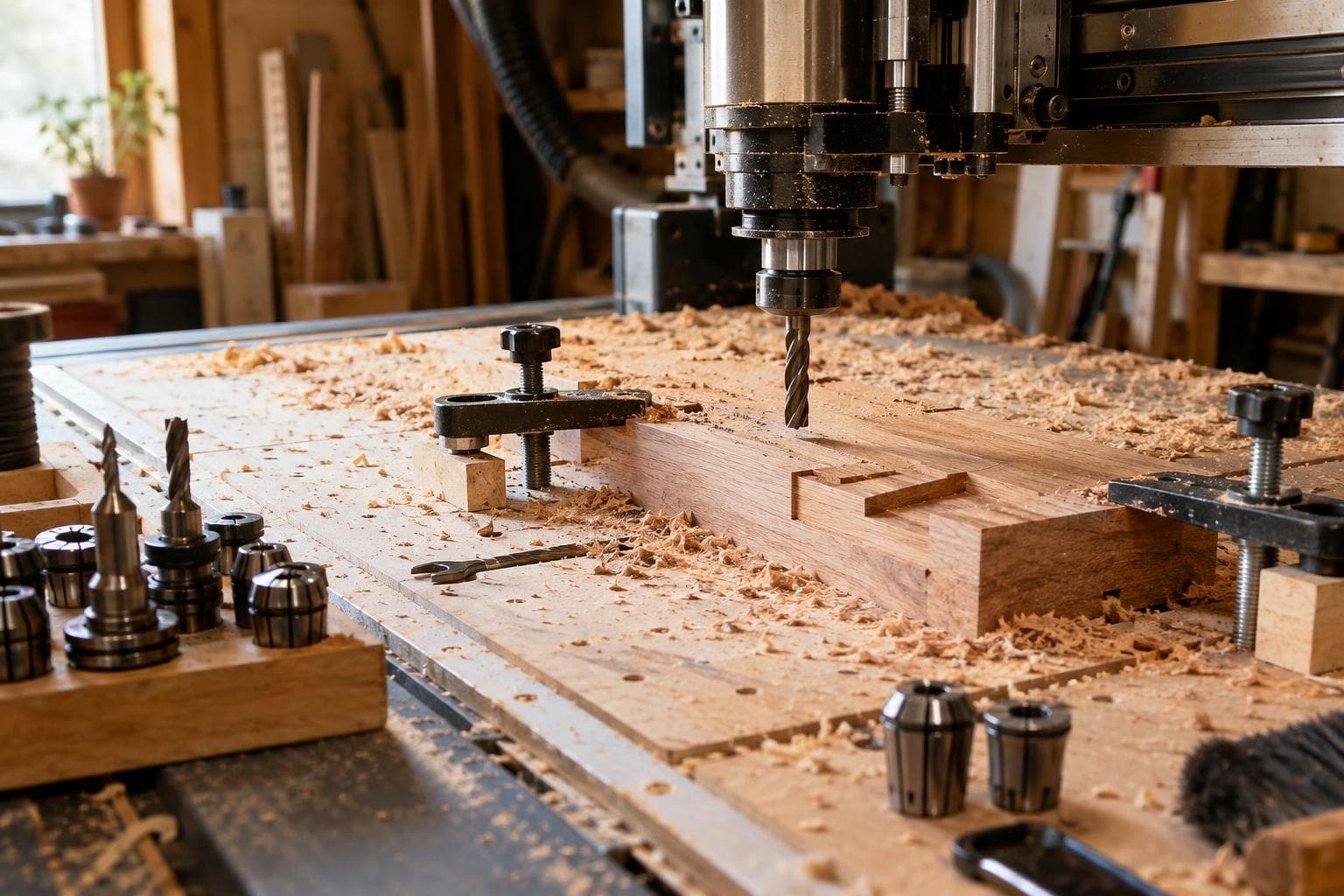
A joint that fits perfectly in October can rattle in January. The short answer is seasonal shrinkage: heating lowers indoor relative humidity when no moisture is added, and solid wood loses moisture with it, shrinking mainly across the grain.
That does not mean every joint needs a loose fit. It means the fit has to be judged against the direction of movement, the moisture condition of the stock, and the job the joint has to perform. Wood movement joinery starts with those three facts.
Why heated rooms dry wood
Air temperature and relative humidity are linked. Warm air can hold more water vapour than cool air, so heating a room without adding moisture usually lowers its relative humidity. The air has not necessarily lost water; its capacity to hold water has increased.
Wood exchanges moisture with that air. It gains moisture in a damp period and gives moisture back in a dry one until it approaches an equilibrium moisture content. The process is gradual, so a thick rail, slab, or post may lag behind the room for days or weeks.
The important direction is across the grain. Wood moves far more across the grain than along it. Across-grain movement includes both radial movement, from the centre of the tree toward the bark, and tangential movement, around the growth rings. Along the grain, length change is usually small enough to ignore in ordinary furniture dimensions, though it is not literally zero.
Species, board orientation, cut, moisture range, and finish all affect the amount. A quarter-sawn board usually changes less in width than a flat-sawn board of the same species, but it still moves. Finish slows moisture exchange; it does not stop it.
What changes inside a joint
Suppose a tenon is cut across the grain of a rail. If the rail dries, its tenon becomes narrower in that same direction. The mortise has not necessarily changed by the same amount, especially if it is in a member whose grain runs differently. Glue may hold the joint, but it cannot prevent the wood fibres from responding to moisture.
The result depends on the joint geometry:
- A cross-grain tenon can become narrower and lose friction in the mortise.
- A long-grain lap or scarf joint may see little length change, but the surrounding boards can still cup or bow.
- A panel captured in grooves can shrink in width while the frame stays nearly the same size.
- A solid tabletop fastened across its width can split, buckle, or pull hardware loose if the attachment blocks movement.
- A drawer or door made from solid stock can change enough to rub in one season and show a gap in another.
This is why a joint becoming loose is not always a machining error. A dimension can be correct when cut and wrong for the later moisture condition. The reverse also happens: a joint cut during a dry heating season may become too tight when the room is more humid.
The key distinction is between a joint that must stay mechanically tight and a part that must be allowed to move. A frame-and-panel door needs a stable frame and a panel that can change width. Gluing the panel into the frame may make the assembly feel stronger at first, but it removes the movement allowance that keeps the panel from splitting.
Predict the fit before cutting
Start by measuring the stock and the room rather than guessing from the calendar. A moisture meter can show whether boards differ from one another, but its reading depends on species, temperature, and the meter's correction method. Treat it as a comparison tool unless it has been calibrated for the material.
A small hygrometer gives useful information about the room's relative humidity. Record both readings over several days if the project matters. One reading taken after opening a door or running a heater is not a seasonal profile.
For a rough movement estimate, use the species' published tangential and radial shrinkage data, then scale it to the change in moisture content over the range that concerns the project. The published values are not universal coefficients for every board. They are usually measured over a defined moisture range and test method, so use the data for the species and cut as a guide rather than treating it as a machining dimension.
A practical fitting routine is more reliable than pretending the estimate is exact:
- Bring the stock into the room where it will live, with stickers between boards so air can reach the faces.
- Measure several locations, not just one end of one board.
- Mark the grain direction on each part before laying out the joint.
- Cut a short test joint from the same board or from a matching offcut.
- Check the fit after the test piece has had time to approach the room condition.
- Leave movement room where a panel, top, or wide solid part crosses the grain.
For a small indoor project, the cheap method is usually good enough: ordinary covered storage in the working room, a basic hygrometer, and a test joint. A dedicated humidity-controlled cabinet is not the first upgrade I would make for one shelf or a small cabinet. It becomes useful when stock must be held at a repeatable moisture condition, when the room swings sharply, or when the project has many close-fitting parts.
Joint choices that survive seasonal shrinkage
The best joint is the one that keeps strength in the load direction while permitting movement elsewhere. That often means changing the attachment method rather than trying to calculate a tighter fit.
| Joint or assembly | Main movement exposure | Likely seasonal failure | Practical response |
|---|---|---|---|
| Mortise and tenon across the grain | Tenon width changes | Joint loses friction or opens at the shoulder | Fit at the expected service condition; orient the tenon for the load and allow movement in adjacent panels |
| Solid panel in a frame | Panel width changes across grain | Panel splits or frame pulls out of square | Use grooves or clips that retain the panel while allowing side-to-side travel |
| Solid tabletop on a cross-grain base | Top width changes against the base | Top cracks, bows, or tears out fasteners | Use elongated holes, buttons, figure-eight fasteners, or another attachment that permits cross-grain travel |
| Dovetailed drawer box | Case width changes across grain | Drawer binds or develops excessive side clearance | Fit the box at service humidity and leave clearance based on board direction and expected movement |
| Narrow edge-glued panel | Each strip changes across its width | Panel cups or joints show stress | Keep grain and moisture condition consistent; do not restrain the panel across its full width |
I would choose a mechanically retained, floating panel over a glued-in solid panel whenever the panel is broad enough for seasonal movement to matter. The floating detail is not a decorative convention; it separates the job of retaining the panel from the job of allowing it to change width.
For a tabletop, I would choose fasteners that let the top move across its width rather than relying on rigid screws through round holes. The attachment must still prevent the top from sliding in the wrong direction, but it should not act like a clamp across the grain.
Fit also has a timing problem. If the final indoor condition will be drier than the shop or garage, cutting a friction fit at the wetter condition can produce a loose joint later. On the other hand, forcing a joint together while the stock is unusually dry can create compression, splits, or a fit that becomes too tight after the room gains moisture.
A bench test for a tight joint
Make the test piece represent the real joint. A narrow offcut does not reveal the same movement as a wide rail, and a sample with different grain orientation can give a false sense of security.
Cut the mating parts with the same tool, feed direction, and setup intended for the final work. Check the joint dry. It should seat with controlled pressure rather than hammering, and it should not depend on wet glue to make up for a poor fit. Mark which face is reference, then measure the joint again after the sample has sat in the intended room condition.
If a joint is loose, do not immediately reduce the cutter size or sand the mating part. First ask which member changed and in which direction. A tenon made narrower by across-grain shrinkage needs a design response, not merely a tighter initial cut. If the joint is tight only during one season, increasing glue or driving it together harder treats the symptom while increasing the chance of a split.
Finishing every face helps the parts exchange moisture more evenly, but it does not cancel movement. End grain generally exchanges moisture faster than a coated face, so end-grain sealing can reduce the speed of change. It cannot make a wide solid board dimensionally fixed.
Frequently asked questions
Will wood joints always get loose during winter?
No. The direction of grain and joint geometry decide the result. A joint may tighten, loosen, or remain nearly unchanged. The common risk is a part whose critical dimension runs across the grain and is cut while the stock is wetter than its winter service condition.
How long should wood acclimate before joinery?
There is no universal number of days. Acclimation depends on board thickness, species, initial moisture content, air movement, and the room's relative humidity. Measure several locations and wait until readings are becoming stable rather than using a fixed calendar rule.
Should solid wood panels be glued into their frames?
Usually not across the panel's full width. Retain the panel in a groove or with hardware that allows it to expand and contract across the grain. Glue can be appropriate for parts whose grain movement is aligned, but it is a poor substitute for a movement allowance.
We build made-to-order custom woodworking through The Boss Factory.
Related services
All services →
Have a project in mind?
Tell us what you want built — we reply within 24–48 hours.