
- craft fair
- market stall
- event selling
- maker business
- pricing
- break-even
Craft Fair Math: Know Your Break-Even Before Booking
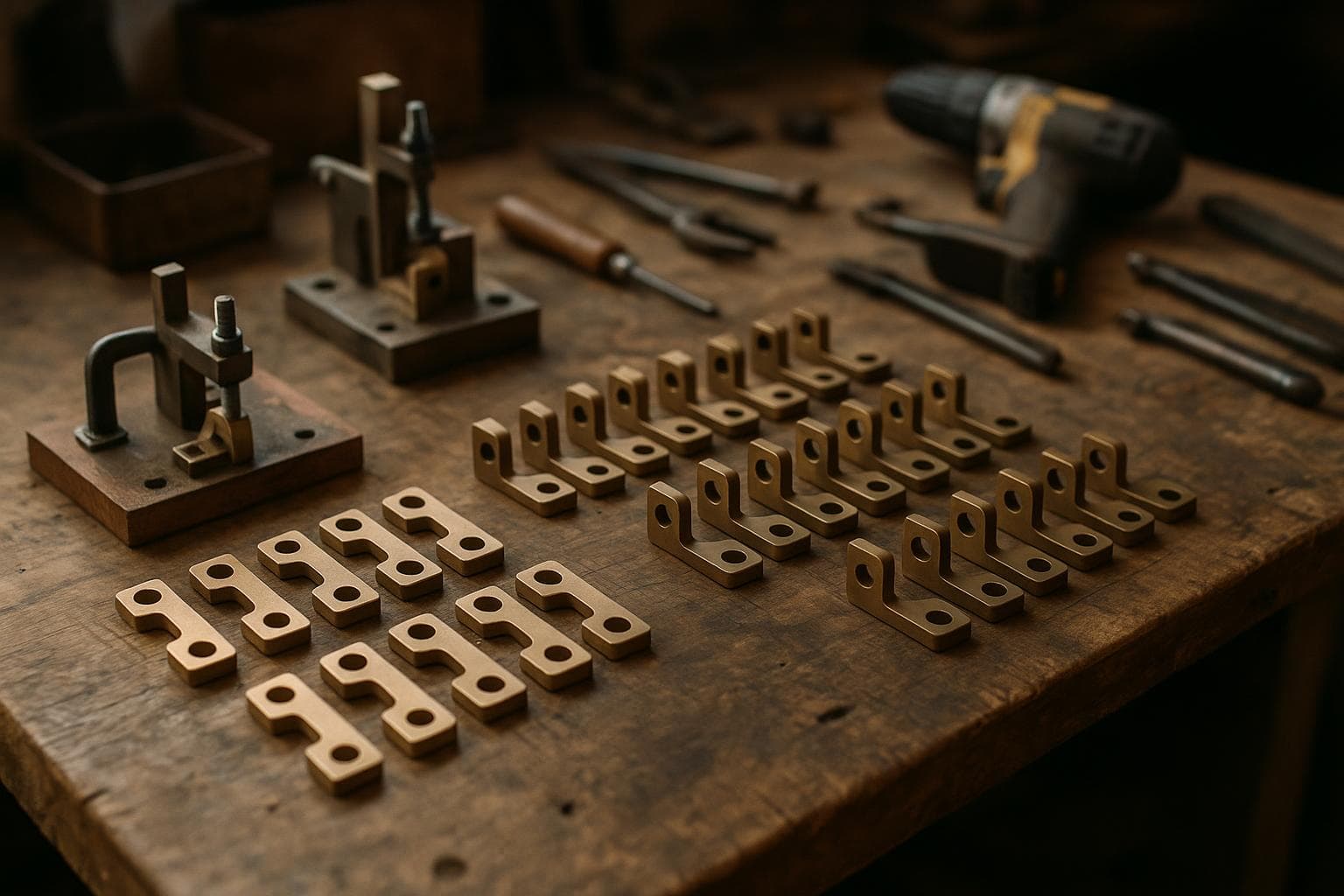
A full table and steady foot traffic do not prove a craft fair was worth doing. The useful question is whether the event pays for the stock, the booth, the travel, and two days of your time. Do the arithmetic before you book, and the answer may be to change the product, change the event, or not sell it there at all.
Calculate the full cost of a market stall
Start with a cost sheet, not a sales forecast. A sales forecast is hope until it has a target beside it. Count every resource the event consumes, including work completed before the vehicle leaves.
Use these lines:
- Booth fee, including required add-ons such as electricity or table rental.
- Travel, parking, accommodation if needed, meals, and payment for transport time if you normally charge for it.
- Display cost allocated to this event. A reusable display that costs about $240 and lasts six comparable events contributes roughly $40 per event.
- Packaging, labels, bags, signage, test pieces, and other consumables used for the event.
- Card and payment-processing fees. These belong in the sales formula because they rise with revenue.
- Material cost for the stock brought to the event.
- Production time for that stock.
- Setup, selling, pack-down, and travel time. Two full event days can easily be sixteen hours before loading and unloading are counted.
- A return for your own time. Use the hourly figure that would make the work worth repeating, not zero because the money is going into your own account.
The production line is the one makers leave out most often. If a batch takes twenty hours to design, cut, print, sand, wire, finish, inspect, and pack, those twenty hours are part of the event cost. The booth is not breakeven just because its fee has been covered by sales.
For a worked example, use rounded planning figures rather than pretending they are universal:
- Booth: $150
- Travel and parking: $80
- Display allocation: $40
- Packaging and other event consumables: $30
- Materials for the stock: $250
- Production: twenty hours at $25 per hour, or $500
- Event time: sixteen hours at $25 per hour, or $400
That is $1,450 before card fees. If card fees average roughly 3 percent of sales, and the event is meant to return another $300 for the risk and interruption, the target is about $1,800 in sales: ($1,450 + $300) divided by 0.97. Round the target upward for planning. If the table cannot plausibly produce that figure, the arithmetic has already answered the question.
This example treats the full batch-preparation cost as belonging to the event. That is a conservative decision when the stock was made specifically for the market. If unsold pieces are durable, plainly useful, and likely to sell through another channel, record their remaining saleable value separately rather than quietly pretending the cost vanished. Do not give yourself credit for an optimistic future sale when deciding whether this particular event paid.
Separate cash breakeven from a worthwhile day
There are two targets, and confusing them causes bad event decisions.
Cash breakeven asks whether the money taken at the table covers the cash that leaves your account: booth, travel, materials, packaging, and fees. Economic breakeven adds your production and event time. A market stall can pass the first test while failing the second by a large margin.
We also set a worthwhile-day target above breakeven. That extra amount can represent profit, compensation for tying up tools and stock, or the value of the work that cannot be done during the event. Pick the reason and write it down. Calling the target “profit” is less useful than stating what it needs to pay for.
For products with different material costs, use a weighted contribution margin rather than one average markup. Contribution is the selling price minus the direct material, packaging, and payment cost for that item. If an item sells for $40 and its direct costs are $12, its contribution before fixed event costs is $28. A product that takes twice as long to make should not be treated as equivalent just because both pieces occupy one square foot of table space.
A practical formula is:
required sales = (event costs + stock production cost + desired return) / (1 - payment-fee rate - variable-cost rate)
Use a variable-cost rate only for costs not already entered as fixed amounts. If materials are listed in dollars for the actual batch, do not also add their percentage of sales. Double-counting makes the target look impossible. Omitting them makes an unprofitable table look busy.
Track three results after the event:
- Gross sales before payment fees.
- Contribution after direct item costs and payment fees.
- Return after every event cost, including all hours.
The third number is the one that decides whether to book the next event. Record it even if the result is negative. A loss with a clear cause can be fixed; a loss described as “a good day” gets repeated.
Use price points to catch more than one buyer
A table with one expensive item asks every browser to make the same large commitment. Many will like the work and still leave. A range of price points on the table converts browsers who will not commit to the largest item, provided the smaller pieces are related in design and made with a margin that survives the event costs.
The ladder does not need to be broad for its own sake. I would usually build three roles into the stock:
- A low-commitment piece that can be understood quickly and bought without a long conversation.
- A middle piece that carries the main contribution and shows the process or material better.
- A larger or more involved piece that establishes the ceiling and gives the table visual weight.
The low-priced item is not a consolation product. It needs a price that pays for its own material, production, packaging, payment fee, and a fair share of the event. If it sells often but loses money, it is a noisy liability.
Price points also change the conversation. A buyer who will not buy the largest piece may choose the middle one. Someone who is still deciding may buy the small one after seeing the larger work. That is why I would rather have three coherent price levels than a table full of nearly identical items at one price.
Do not make the largest piece so cheap that it anchors the whole table downward. Conversely, do not use an expensive item as decoration if it absorbs production time that the sales target cannot recover. Its job must be clear: margin, demonstration, or a credible upper price point.
Make the event stock with the machine, not against it
The event calculation exposes which products are suitable for repeated production. Machine time, bench time, finishing, inspection, and failure rate matter more than the raw material price.
| Production class | Machine and bench time | Tolerance risk | Common failure mode | Cost per part | Best role at a market stall |
|---|---|---|---|---|---|
| Repeatable flat work | Usually shorter machine cycles; finishing and packing can dominate | Alignment, warping, edge quality, and surface marks | A batch defect or poor finish affects several pieces | Usually lower when nesting is efficient | Low or middle price point with dependable replenishment |
| Assembled electronic work | Machine time may be modest; wiring, testing, and fault finding dominate | Fit, polarity, connector strain, and enclosure clearance | A unit powers on inconsistently or fails inspection | Usually higher because test time is part of every unit | Middle or upper price point only if testing is repeatable |
| Large one-off work | Setup, handling, and finishing can exceed cutting or print time | Stock movement, joining, and final fit | Damage during transport or an unfinished surface consumes the margin | Usually high and difficult to average | Upper price point or display sample, not bulk stock |
For a repeatable batch, time one complete unit through the whole process. Do not multiply only the machine estimate. For a laser-cut part, include masking, cleaning, edge inspection, and assembly. For a CNC part, include fixturing, tool changes, sanding, and the time spent dealing with a part that shifts. For a 3D-printed part, include support removal, surface checks, and failed prints. For an electronic item, include a powered test and the time to diagnose a failed unit.
The cheap way is often good enough here: use the existing fixture, packaging, and machine settings for a product that already passes inspection. An upgrade that reduces a ten-minute task to eight minutes does not fix a product whose real problem is an hour of hand finishing or weak demand. Do not buy a new tool until the time sheet shows that the tool addresses the largest repeated cost.
Run a small production test before committing to event stock. Measure elapsed time from raw material to packed unit, count rejects, and note where work queues form. Then price from the measured average, not from the fastest successful part. A batch with a 1-in-10 failure rate has a different cost per sellable unit from a batch with no rejects, even if the machine settings are identical.
Turn the target into a booking decision
Before paying the booth fee, write a one-page event estimate with three scenarios: poor, expected, and strong. Use units sold and the actual price mix, not foot traffic. A stall that needs forty middle-priced sales should not be justified by a forecast of thousands of visitors.
Check these questions:
- How many sellable units can be made without displacing better-paid work?
- What fraction of the stock can realistically be sold at this event rather than later?
- Does the expected price mix reach the worthwhile-day target after fees?
- Can the display show the work without adding a new construction project?
- Is the product quick to explain, inspect, pack, and take home?
- What is the loss if the event is quiet and the stock remains unsold?
If the answer misses the target, change one variable at a time. Reduce production time, simplify the finish, raise the price, make fewer units, choose a cheaper display, or select an event with a buyer profile that matches the work. Cutting your own hourly rate should be near the bottom of the list, not the first adjustment.
There is also a valid answer that involves no table. If the product needs a long explanation, has a high failure cost, takes too long to make, or has a price that the event audience will not support, do not sell that product at a craft fair. Keep it for a sales channel where the buyer can compare specifications and you are not paying for two full days of access to them. A product can be good work and still be the wrong event product.
Frequently asked questions
Should I count my own time if I am not paying myself that day?
Yes. Count it at the hourly rate that makes the activity worth repeating. If you leave it at zero, the calculation answers whether the event generated cash, not whether it was a viable business activity.
How much stock should I make for a craft fair?
Make enough to support the planned price mix without putting the full event at risk. Start with the number of units your production test can make and inspect reliably, then compare their contribution with the worthwhile-day target. More stock is not a strategy if it only creates more unsold labor.
What if the event covers its booth fee but not my time?
Treat it as a failed economic test unless you deliberately chose the event for a different measurable reason. If the product or audience has future value, record that value separately and set a deadline for proving it. Do not use vague exposure to hide a recurring loss.
The Boss Factory builds made-to-order work for event displays through Custom Woodworking, Laser Cutting & Engraving, and Design & Product Development; request a quote.
Related services
All services →
Have a project in mind?
Tell us what you want built — we reply within 24–48 hours.