

- board feet
- rough lumber
- lumber pricing
- woodworking
- material estimating
Board Foot Calculation: Price Rough, Build with Finished
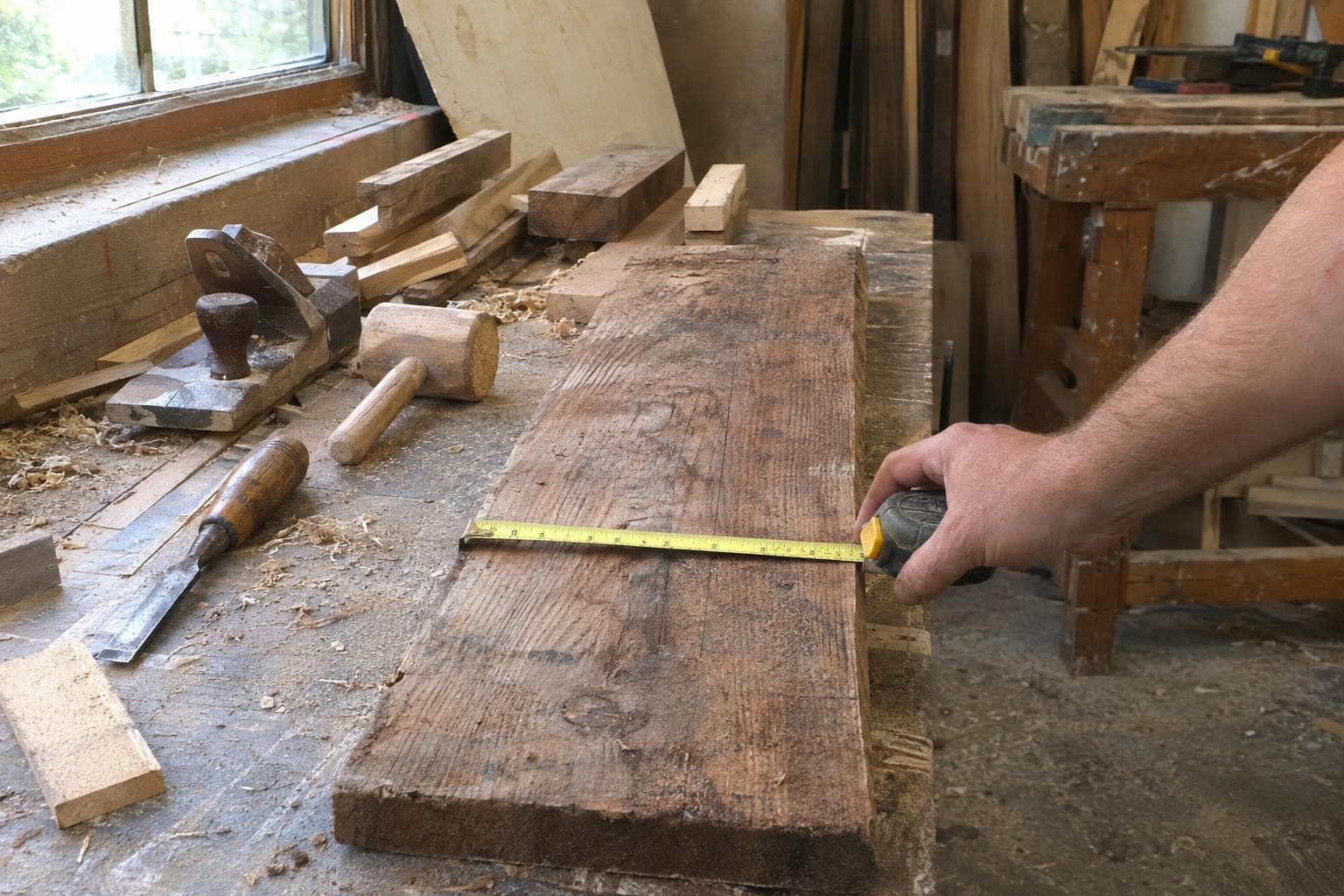
A board foot calculation answers two different questions that are easy to mix up: how much rough lumber you are buying and how much finished material will remain. The short answer is to price the rough dimensions, then plan the project around the milled dimensions, not the number on the invoice.
What a board foot measures
A board foot is 144 cubic inches. The standard calculation is:
nominal thickness in inches × width in inches × length in inches ÷ 144 = board feet
The word nominal matters. Lumber is commonly sold by a rough thickness designation such as 4/4, 5/4, or 8/4. The designation describes the stock before milling, not the final thickness of your part.
For one rough board marked 4/4, 8 inches wide, and 8 feet long, say the arithmetic out loud:
Four quarters times eight inches times ninety-six inches, divided by 144, equals 5.33 board feet.
The board contains about 5.33 board feet on that purchase basis. The fraction is not a defect, and rounding every board up to the next whole board foot can distort a material estimate. Keep the unrounded result in your worksheet, then round the final purchase quantity in a way that matches how the lumber is sold.
For a board with dimensions in feet, convert length to inches before calculating. An 8-foot board is 96 inches, not 8 in the formula. If a supplier quotes by board feet, use the dimensions and measurement convention stated for that stock. Rough boards are often irregular, so the usable amount can be less than the geometric volume suggests.
Separate buying thickness from finished thickness
The most common beginner error is multiplying the finished thickness by the rough board's width and length, then treating that result as the amount purchased. That undercounts the material you pay for.
Four-quarter rough stock usually finishes near three quarters of an inch after milling. That is a useful planning assumption, not a promise. A cupped, twisted, rough, or damaged board may need more removal. A board that is already surfaced may have a different measurement basis entirely.
Here is the same example viewed from both sides:
| Stock condition | Thickness used for purchase math | Expected working thickness | Main technical risk | Planning use |
|---|---|---|---|---|
| Rough 4/4 stock | 1 inch nominal | Near 3/4 inch after milling | Defects or warp require extra removal | Price the lumber and reserve material |
| Surfaced 3/4 stock | 3/4 inch actual or stated | Near the stated thickness | Less allowance for flattening or correction | Size parts that do not need much milling |
| Rough 5/4 stock | 1 1/4 inches nominal | Depends on defects and milling allowance | Paying for extra thickness that may become waste | Choose for thicker parts or deeper correction |
Suppose the finished part needs to be 3/4 inch thick. Start with 4/4 rough stock only if the boards are sound enough to reach that thickness. The board foot calculation for buying still uses 1 inch nominal thickness. The finished part may use less volume because milling removes material, but that does not change the amount of rough stock purchased.
The same distinction applies to width. A rough board described as 8 inches wide may have bark, wane, a live edge, a damaged corner, or an area that must be removed. Do not assign every square inch of that width to finished parts until you inspect the board and establish a straight reference edge.
Make the estimate before buying rough lumber
Start with the parts list, then work backward to the rough blanks. For each part, record finished length, finished width, and finished thickness. Add allowances for jointing, planing, trimming, saw kerfs, defects, and grain direction.
A usable sequence is:
- Group parts by finished thickness so one rough board can serve several parts.
- Add extra length for end checks and the final crosscut.
- Add extra width for establishing a straight edge and removing wane.
- Keep the rough thickness separate from the finished thickness in your notes.
- Calculate board feet per board, not only for the total project.
- Mark boards with defects before deciding which parts they can supply.
- Add a practical waste allowance based on board quality and part size, rather than using one fixed percentage for every species and layout.
For a 3/4-inch-thick part, a rough blank might begin at 1 inch thick, then lose material during flattening and thicknessing. If the board is already flat and clean, the allowance can be modest. If it is twisted or cupped, the first face may need substantial correction before the opposite face can be made parallel.
This is where lumber pricing becomes more than a multiplication exercise. Two boards with the same board-foot quantity can yield different amounts of clear, straight, usable stock. Short parts can often be nested around defects. Long, wide parts cannot. Price the rough volume, but judge value by the finished parts it can actually produce.
Check the calculation at the bench
Before milling the whole board, verify the dimensions and the intended yield. This check catches unit mistakes, optimistic widths, and a finished thickness that was copied into the purchase calculation.
Use this sequence:
1. Read the stock designation
Confirm whether the board is rough 4/4, rough 5/4, surfaced on one or both faces, or already machined to a stated thickness. Do not assume a board marked by a nominal fraction still measures that fraction with calipers.
2. Measure the useful envelope
Measure length after allowing for checked ends. Inspect both edges and the face. Record the width that can become a straight-edged blank, not the widest point that includes unusable bark or a corner defect.
3. Say the purchase arithmetic aloud
For a rough 4/4 board that is 8 inches wide and 96 inches long:
One inch nominal thickness times eight inches width times ninety-six inches length, divided by 144, equals 5.33 board feet.
That is the rough purchase quantity. Do not replace the one inch with three quarters just because three quarters is the intended finished thickness.
4. Say the finished arithmetic separately
If the board mills to 3/4 inch thick and the usable width becomes 7 1/2 inches, the remaining rectangular volume is:
Three quarters inch times seven and one half inches times ninety-six inches, divided by 144, equals 3.75 board feet of finished rectangular stock.
This second number is not a revised invoice. It is a yield check. It shows why rough board feet and finished board feet are not interchangeable.
5. Compare the result with the parts list
Add the finished volumes of the parts, then compare them with the finished stock available after defects and saw cuts. If the yield is too close, choose a wider board, a longer board, thicker rough stock, or a different layout. Do this before cutting the first part.
Common mistakes that change the answer
The most damaging mistakes are usually small notation errors:
- Using feet for length while leaving width and thickness in inches.
- Treating 4/4 as a finished one-inch board.
- Counting the full rough width when the edge will be jointed away.
- Ignoring end checks, knots, bark, and cracks in the usable-length estimate.
- Adding a waste percentage without checking whether the parts can actually nest around defects.
- Mixing board feet, square feet, and linear feet in the same worksheet.
- Rounding each board before adding the total, which can accumulate error.
For most one-off furniture parts, we would rather buy the right rough thickness and inspect the boards than pay for a precision-surfaced upgrade that removes the useful milling allowance. Surfaced stock is convenient when the final dimension is already known and the parts are small, but it does not fix a layout problem or create clear material from a defective board. Do not buy a thicknessing or surfacing upgrade to solve a yield problem that better part nesting would solve.
Frequently asked questions
Is a 4/4 board really one inch thick?
No. Four-quarter is a rough-stock designation based on a nominal thickness of 1 inch for board-foot calculation. After milling, four-quarter rough stock usually finishes near 3/4 inch, depending on the board's condition and how much material must be removed.
Do I calculate board feet from finished dimensions?
Use rough or nominal purchase dimensions for the amount you are buying. Use finished dimensions separately to check yield and confirm that the stock can supply the parts. Combining those two stages understates the purchase quantity.
How much waste should I add to a lumber estimate?
There is no reliable single allowance for every board and project. Waste depends on defects, part length, required grain direction, roughness, board width, and how much flattening is needed. Inspect the actual boards, lay out the parts, and add material when the yield check leaves no room for a defect or a final trim.
The Boss Factory builds made-to-order custom woodworking, custom signs, and CNC precision cutting; request a quote.
Related services
All services →
Have a project in mind?
Tell us what you want built — we reply within 24–48 hours.