

- work area
- cnc
- machine setup
- tiling
- maker tips
CNC Work Area: How Much Space Do You Need?
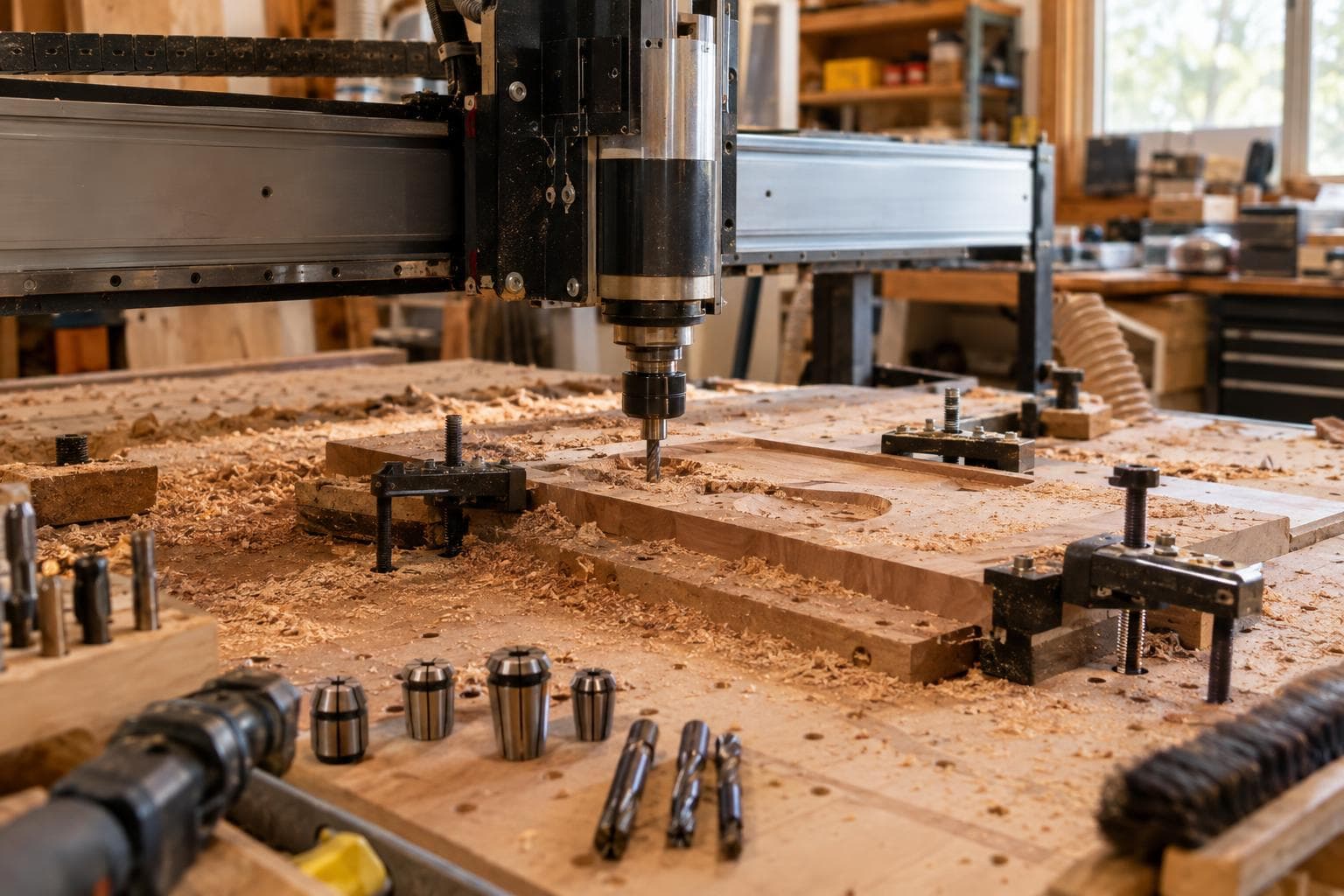
The machine may fit on the bench and still fail the job because the material cannot get to it. The honest answer is that you need enough usable travel for the part, plus room to load, support, clamp, and remove the material. Work area is the usable length, width, and height a machine can reach, not the outside size of its frame.
That definition changes the buying decision. A machine that accepts a full sheet takes a room to itself once loading space and access are included, while a smaller machine can handle large panels through tiling large jobs. Tiling is not an admission that the machine is inadequate; it is a production method that depends on repeatable re-registration between positions.
Work area is the cutting envelope, not the bed label
Manufacturers describe machines with travel figures, bed dimensions, or both. These are not interchangeable.
A CNC with 600 mm of X travel may lose usable space to clamps, a dust shoe, the cutter diameter, or a boundary the control software refuses to cross. A laser may have a bed that fits the material but need open space at the front or side for loading.
For a flat part, start with the finished geometry and add the requirements that surround it:
- Leave room for the cutter, nozzle, or laser head to reach the edge without striking clamps or fixtures.
- Add a margin for hold-down hardware and for the material’s actual square edges, which may not match the nominal sheet size.
- Check the machine’s Z clearance with the real stock, spoilboard, fixture, and tool installed.
- Measure the loading path, not only the table: doors, walls, benches, and nearby machines can block a sheet before it reaches the bed.
- Leave access to the controls, emergency stop, dust collection, ventilation, and maintenance points.
The clearance around the travel is part of the machine’s footprint. A full-sheet CNC may have enough X and Y travel for the panel yet still require several feet of open space on one or more sides to support and rotate the sheet safely. That space is not optional gantry clearance. It is material-handling clearance.
The measurement that decides the machine
Measure the largest job you expect to make repeatedly, then separate three dimensions that are often mixed together:
- Part size: the finished dimensions of the object.
- Process envelope: the space needed for the tool, fixture, clamps, tabs, lead-ins, and safe movement.
- Handling envelope: the room needed to load, support, turn, inspect, and remove the material.
For a panel cut from a sheet, the process envelope can be only slightly larger than the panel. The handling envelope can be several times larger, especially with rigid plywood or a long board that must be kept level while loading.
For most hobbyists, the best choice is not the largest machine that fits on paper. It is the machine that fits the work area with enough access to be used without dismantling the room every time. If your regular parts fit a compact bed, buying a full-sheet machine is an expensive way to solve a handling problem you do not have.
When tiling is the better technique
Tiling divides a large design into sections that fit the machine. Each section is cut or engraved in a separate position, then the material is moved and registered again for the next section. The machine does not need the full job in its travel envelope, but the fixture and the registration method must make every position predictable.
A workable tiled setup normally has:
- A straight reference edge or fixed fence that does not move with the sheet.
- Registration pins, dowels, holes, stops, or another feature that locates the sheet again.
- A coordinate system shared by the design files, with a known overlap or seam between tiles.
- Enough sacrificial area for clamps and tabs without placing them in the next tile’s cutting path.
- A test mark or shallow reference cut before committing to the full material.
The critical requirement is repeatable re-registration between positions. Tape marks on a moving sheet are not a registration system unless they are backed by a fixed reference that can be found again with useful accuracy. A fence can control one edge while pins control movement across the sheet.
Tiling works well for signs, decorative panels, cabinet parts, and other jobs where a seam can be hidden or the final tolerance is moderate. It is a poor fit for a part that must remain one uninterrupted surface with no visible transition, or for geometry whose accuracy depends on every tile sharing the same coordinate origin.
Do not assume the error automatically becomes harmless because each tile is small. A small registration error can show as a step at a seam, a doubled line, a mismatch in a pocket, or a hole that no longer lines up. Run a registration test in scrap material first. Cut two adjacent tiles with a shared feature and measure the result before using the good sheet.
Full sheet versus tiled workflow
| Technical factor | Full-sheet setup | Tiled setup |
|---|---|---|
| Material handling | Needs broad loading and support clearance around the machine | Needs a stable way to move or reposition the sheet without losing reference |
| Setup time | More time spent loading, supporting, and securing one large sheet | More time spent creating references and repeating setups |
| Registration tolerance | One setup avoids tile-to-tile re-registration error | Depends on repeatable re-registration between positions |
| Failure mode | Poor support can cause vibration, sag, or an unsafe load | Misalignment can create seams, doubled cuts, or shifted features |
| Cost per part | Can be efficient for repeated large parts once the setup is ready | Can be efficient when the smaller machine already exists and the extra setup is acceptable |
| Best use | Large uninterrupted surfaces and parts needing one coordinate system | Large designs that can be divided without damaging appearance or fit |
Our default choice for a hobbyist is the smaller machine plus a proper tiling fixture, provided the work tolerates seams and the registration test passes. The larger machine earns its floor space when full-sheet work is frequent, handling large stock is already practical, or the design cannot tolerate a join. Tiling is cheap enough to be good enough for many signs and panels; it is not a universal substitute for travel.
Plan the job before measuring the machine
Draw the actual material rectangle in CAD, including the edge you will reference. Place the design inside it, then mark clamps, tabs, tool clearance, and tile boundaries. This reveals whether the limiting dimension is the machine’s travel, the sheet’s handling path, or the fixture.
For laser work, check the usable bed area and the path for feeding or repositioning the material. A large engraved sheet may be easier to tile than to carry into a machine with limited front access.
For 3D printing, treat build volume as the part envelope and check the printer’s door, lid, spool path, and service access separately. A part that fits diagonally in the slicer may still be awkward to remove or impossible to orient without support.
The best measurement is a dry run with cardboard or scrap stock. Put the machine where it will live, place the largest planned material on the loading path, and perform the complete motion without cutting. If the sheet hits a wall, the machine is not effectively large enough for that job.
Frequently asked questions
Is work area the same as machine size?
No. Machine size is the outside footprint. Work area is the usable travel or build envelope, while the practical footprint also includes loading, support, operator access, extraction, and maintenance clearance.
Is tiling accurate enough for CNC work?
It can be, if the sheet is held against fixed references and each position re-registers repeatably. Test adjacent tiles in scrap material and measure shared features before cutting the final sheet. The required registration accuracy comes from the joint, hole pattern, seam, or surface finish in the finished part.
Should I buy a larger CNC or tile large jobs?
Choose tiling if large work is occasional and the design can accept divided operations. Choose full-sheet travel if large uninterrupted parts are routine or if the setup cannot tolerate a visible or functional seam. Do not buy the larger machine until the smaller machine and a tested fixture have proved inadequate.
We build CNC-cut work, laser-cut pieces, and FDM 3D-printed prototypes to order through /quote.
Related services
All services →
Have a project in mind?
Tell us what you want built — we reply within 24–48 hours.