

- esp32
- esp8266
- microcontrollers
- bluetooth
- adc
- maker electronics
ESP32 vs ESP8266: Which Belongs in Your Build
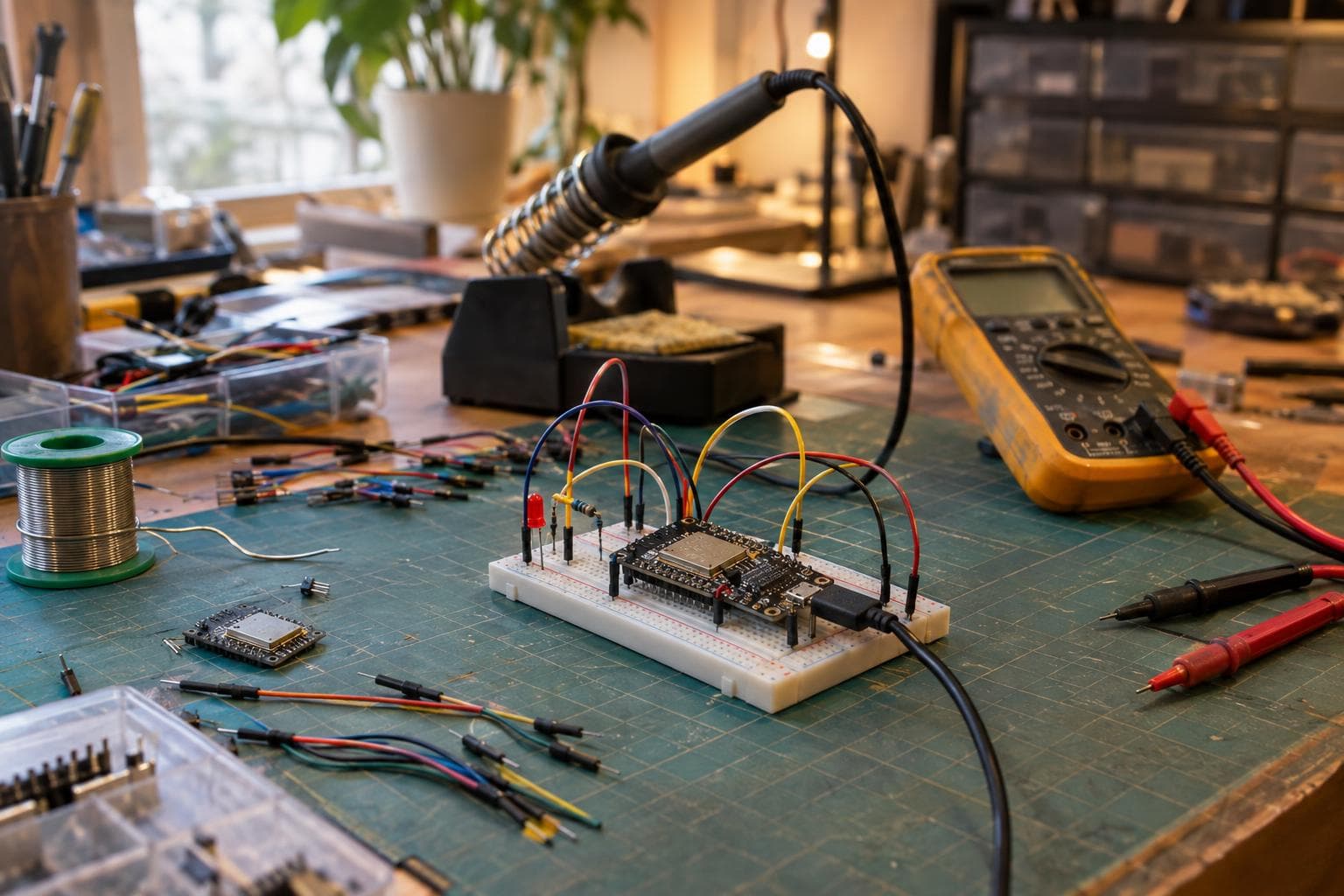
The real question in an ESP32 vs ESP8266 decision is not which board has the longer specification sheet. It is whether your project needs extra pins, cleaner analog options, Bluetooth, or more processing headroom. For a basic Wi-Fi sensor or switch, the ESP8266 is still a sensible low-cost choice; for a new build with room to grow, we usually choose the ESP32.
Start with the job, not the board name
Both families can connect to a 2.4 GHz Wi-Fi network and run the usual maker firmware stacks. Both can read digital inputs, drive LEDs, control transistors, and exchange data over serial, I2C, or SPI. That overlap is why the ESP8266 remains useful.
The difference appears when the project has several jobs happening at once. A controller that reads a sensor, serves a web page, updates a display, drives outputs, and keeps a reliable network connection has less spare capacity on the ESP8266. The ESP32 gives that work more room, along with peripherals that would otherwise require another board.
The chip family names need a qualifier. The common original ESP32 modules, including boards based on ESP32-WROOM-32, use a dual-core processor and support Bluetooth Classic and Bluetooth Low Energy. The ESP8266 has one CPU core and no Bluetooth. Other chips sold under the ESP32 family name vary; for example, the ESP32-C3 is single-core and supports Bluetooth Low Energy rather than Bluetooth Classic. Check the exact chip on the board before designing around a feature.
The specifications that change wiring and firmware
| Decision factor | ESP8266 | Common original ESP32 | What changes in the build |
|---|---|---|---|
| CPU arrangement | Single core | Dual core | Network handling and application work have more scheduling headroom on the ESP32, though firmware still needs careful timing |
| Bluetooth | None | Bluetooth Classic and BLE | A phone, beacon, or nearby wireless accessory can connect without adding another radio on common original ESP32 modules |
| Analog input | One 10-bit ADC input | Two 12-bit ADC blocks | The ESP32 can accept more analog channels and resolves smaller voltage steps, subject to calibration and pin restrictions |
| Digital pin access | Fewer practical GPIO choices on typical boards | More practical GPIO choices, with input-only and boot-strap pins to avoid | Displays, buttons, relays, and sensors are easier to allocate on the ESP32, but the board pinout still decides what is safe |
| Wi-Fi and application load | One core shares time between both | Two cores on common original ESP32 variants | A busy web interface, display, or protocol parser is less likely to interfere with sensor timing on the ESP32 |
| Power budget | Usually the easier low-power starting point | Usually needs more careful power planning | Battery life depends on sleep mode, radio duty cycle, regulator, peripherals, and firmware rather than the chip label alone |
Analog input is a practical dividing line
The ESP8266 exposes a single 10-bit analog input. That is enough for one potentiometer, a light-dependent resistor, a simple battery monitor, or a sensor module that already converts its signal into a suitable voltage. On many ESP8266 development boards, the board adds a resistor divider to the bare ADC pin, so the permitted external voltage depends on the board rather than the ESP8266 chip alone.
The common original ESP32 has two 12-bit ADC blocks. That gives more analog channels and finer nominal resolution than the ESP8266's single 10-bit input. It does not make the ESP32 ADC a laboratory instrument. The ADC can be non-linear, readings can be noisy, attenuation changes the usable voltage range, and on classic ESP32 hardware ADC2 has restrictions while Wi-Fi is active. A voltage divider, reference measurement, averaging, and calibration still matter.
For a sensor that must be read while Wi-Fi is running, verify the exact ADC pin and framework behavior before routing the board. If the signal needs stable accuracy, an external ADC may be the better fix. Buying an ESP32 does not remove the need to condition a noisy or out-of-range signal.
GPIO count is less useful than GPIO availability
The ESP32 generally gives a project more usable GPIO than the ESP8266, but counting pins printed on a product page is not enough. Some ESP32 pins are input-only. Some are used for flash or other board functions. Some affect boot mode and must be held at the right level during reset. The ESP8266 also has boot-sensitive pins, and its development board may connect certain pins to the USB-to-serial circuit or onboard LED.
Before choosing either board, make a pin schedule:
- Reserve pins for the programming and serial interface until you know how the board handles them.
- Mark boot-strap pins and avoid attaching circuits that force the wrong level at reset.
- List each input, output, bus, interrupt, and analog channel with its voltage requirement.
- Check whether a peripheral library assumes a particular hardware bus or timer.
- Leave one or two pins available for troubleshooting, status indication, or a revision.
This exercise often exposes the real decision faster than comparing headline GPIO counts. A board with enough pins on paper can still be awkward if the needed pins cannot coexist with Wi-Fi, boot, or analog functions.
Processing, Bluetooth, and timing
The ESP8266's single core is not a defect in a small controller. It is adequate for a temperature node that wakes, reads one sensor, sends a value, and sleeps. It also suits a simple relay, button panel, or display with modest refresh needs. In those projects, the lower board cost and smaller software surface can matter more than extra capability.
The common original ESP32's second CPU core becomes useful when the application has competing timing demands. Bluetooth activity, Wi-Fi traffic, a web server, sensor sampling, audio-like data streams, and display updates can all consume time. A second core does not automatically make poorly structured firmware safe. Shared data still needs synchronization, blocking calls still cause trouble, and interrupt handlers still need to stay short. The extra core gives better room for separation, not permission to ignore scheduling.
Bluetooth is a similarly concrete choice. If the device must pair with a phone, read a BLE sensor, or exchange data with a nearby accessory, the ESP32 can remove a separate radio module. If every connection is Wi-Fi or wired serial, Bluetooth is unused silicon and should not decide the purchase by itself.
Cost, power, and the cheap option
The ESP8266 is often cheaper, and that difference matters in a project using many identical nodes. A design that needs one ADC channel, a few digital outputs, Wi-Fi, and no Bluetooth does not become better because it uses an ESP32. In that case, the ESP8266 is the option we would pick, provided its ADC voltage and pin boot behavior fit the circuit.
The ESP32 usually consumes more power during active work, though the result depends on radio use, sleep configuration, regulator losses, attached sensors, and board design. A development board's USB interface, power LED, and regulator can dominate sleep current. Measure the complete board with the peripherals attached instead of copying a chip-only figure into a battery estimate.
The cheapest board also becomes expensive if it forces a redesign. Paying for an ESP32 is reasonable when adding a second MCU, an external Bluetooth module, an ADC, or a GPIO expander would cost more in wiring and firmware effort. It is not reasonable when the project has no need for those parts.
A decision you can make before ordering
Choose the ESP8266 when all of these are true:
- Wi-Fi is the only wireless link.
- One analog input is enough.
- The analog signal fits the particular board's ADC input range.
- The pin schedule works without risky boot-pin tricks.
- The firmware has one modest control loop rather than several competing workloads.
- Low board cost and simple deployment matter more than expansion room.
Choose a common original ESP32 board when any of these are central:
- Bluetooth Classic or BLE is part of the connection plan.
- Two ADC blocks and multiple analog channels are useful.
- The project combines Wi-Fi with a display, web interface, logging, or frequent sensor work.
- You need more practical GPIO and can check the exact board pinout.
- A future revision may add inputs, outputs, or a local wireless accessory.
For a first prototype with uncertain requirements, our default is the ESP32, but not because every project needs its full specification. The extra GPIO, ADC capacity, Bluetooth, and second core reduce the chance that a small feature addition forces a board change. For a fixed, simple Wi-Fi device, the ESP8266 remains the honest buy and the upgrade fixes a problem you do not have.
Frequently asked questions
Is the ESP32 always better than the ESP8266?
No. It is more capable, but capability has a cost in board price, power use, pin complexity, and firmware choices. A one-sensor Wi-Fi node with no Bluetooth is often well served by the ESP8266.
Can I use the ESP32 ADC while Wi-Fi is active?
Yes, but on classic ESP32 hardware, ADC2 channels have restrictions while Wi-Fi is running. ADC1 is the safer group for measurements that must coexist with Wi-Fi, subject to the exact chip, board routing, attenuation, and software framework. Confirm the pin mapping in the datasheet and board documentation.
Does the ESP8266 have enough analog resolution for a battery monitor?
It can, if the battery voltage is reduced with a correctly calculated divider and the board's ADC range is respected. Its single 10-bit ADC gives fewer code steps than the ESP32's 12-bit ADC blocks, so measure a known voltage, account for divider tolerance, and calibrate if the reading affects a real cutoff decision.
The Boss Factory builds made-to-order custom electronics and design and product development work; request a quote.
Related services
All services →
Have a project in mind?
Tell us what you want built — we reply within 24–48 hours.