

- poe
- sensors
- electronics
- networking
- power
PoE Sensor Power: Passive Injector or Negotiated?
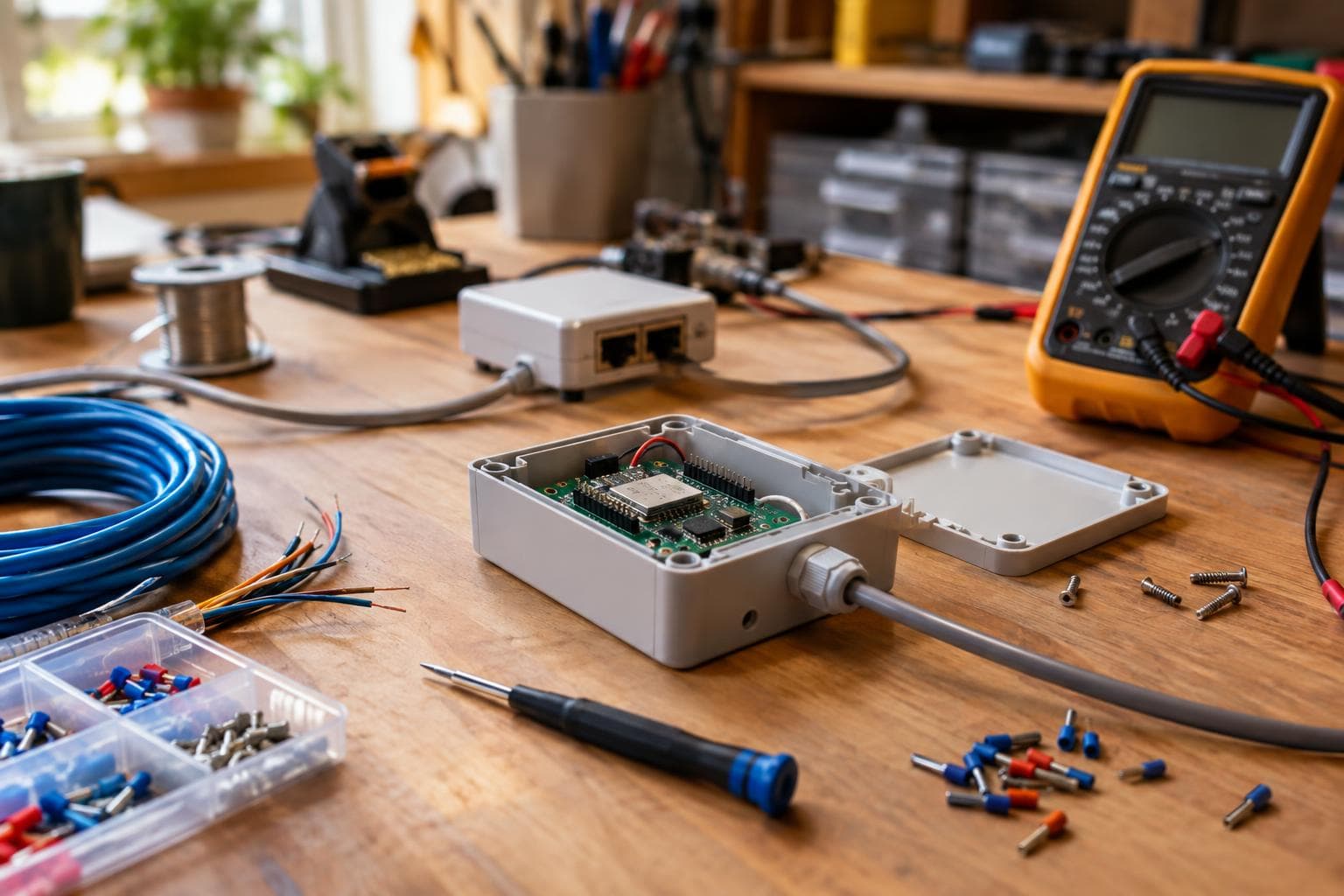
A fixed sensor often needs one cable to reach a useful location, but power over that cable has two very different meanings. The short answer is to use standards-compliant PoE for equipment that must survive unknown wiring or connection mistakes; passive injection is suitable only when every part of the link is under your control.
Start with the sensor location, not the injector
A poe sensor installation earns its cable when the mounting point is distant from a convenient outlet, sits above a ceiling, or needs a clean service path back to a switch or control cabinet. One Ethernet cable can carry data and power, which removes a local mains adapter and usually makes the enclosure easier to inspect.
That does not mean PoE is automatically the cheapest method. A nearby outlet with a certified low-voltage power supply can beat PoE for a single indoor sensor, especially if Ethernet already reaches the enclosure for data. The decision turns on four practical questions:
- Is the cable route shared with equipment you do not control?
- Must the sensor continue operating after replacement or rewiring?
- Does the enclosure need galvanic isolation from the cable and its upstream equipment?
- Will the installation grow beyond one or two nodes?
For a single prototype on a bench, a separate supply is often the sensible choice. For fixed nodes spread through a building, one managed power and data path usually pays back in wiring and service work rather than raw component cost.
Passive injection and negotiated PoE are different electrical systems
A standards-based Power over Ethernet system detects a compatible powered device and negotiates before applying voltage. The power-sourcing equipment checks the signature presented by the powered device, then uses classification or an equivalent standard procedure to establish what the device can receive. A compliant powered-device module is designed to participate in that process.
A passive injector does none of this. It applies voltage to the designated pairs unconditionally, as soon as its supply is present. The voltage may be correct for the intended sensor and still be wrong for any other device that gets connected later.
That distinction matters at the connector, not just in the wiring diagram. A passive injector plugged into a device that expects negotiation can damage that device. A normal Ethernet port, a computer, or a non-PoE sensor interface is not protected merely because the cable uses familiar RJ45 connectors. Labelling the cable helps, but it does not create electrical protection.
Passive injection is reasonable for a closed system where the injector, cable, splitter, and sensor input are specified as one arrangement. It is a poor choice for a mixed network, a temporary test lead, or a connector that technicians may repatch without checking the source.
For power over ethernet diy work, treat a passive injector as a fixed-voltage supply distribution method, not as a cheaper version of standards-based PoE. That framing prevents the most common design error: assuming the connector makes the power safe.
What a proper PoE module contributes
A standards-compliant powered-device module is more than a pair of Ethernet wires feeding a buck converter. The module normally combines the detection and classification interface, bridge rectification or polarity handling as required by the design, input protection, an isolated conversion stage, and a regulated output. The exact arrangement depends on the module and the PoE standard it supports, so the datasheet and reference circuit decide the details.
Isolation deserves separate attention. Ethernet magnetics provide signal isolation, while a suitable PoE powered-device design commonly uses an isolated DC/DC converter to separate the cable-side power domain from the sensor-side low-voltage domain. That barrier limits a fault or ground-potential difference from becoming a direct path through the sensor electronics. It also makes cable shield, chassis, and signal-ground decisions easier to reason about.
Do not assume every board sold as a PoE splitter has the same isolation. Check for an explicit isolation specification, the isolation test voltage, creepage and clearance information, output voltage range, and allowed power. A non-isolated regulator after a passive injector may produce the voltage you need, but it does not provide the same fault boundary.
The module also changes the enclosure work. Keep the cable entry, surge or transient protection, and mains-adjacent parts physically separate from the sensor, processor, and exposed terminals. Provide strain relief before the cable reaches the PCB. If the sensor is outdoors or on a long route, environmental protection and surge behavior may matter more than the nominal wattage.
Compare the three practical methods
The table uses system-level behavior rather than product labels. “Cost per node” includes the power hardware around the sensor, not the sensor itself.
| Method | Negotiation and fault behavior | Isolation | Wiring and service | Current and temperature limits | Cost per node | Best fit |
|---|---|---|---|---|---|---|
| Standards-compliant PoE powered-device module | Detects and negotiates before voltage is applied; protects against ordinary misconnection better than passive injection | Usually available through an isolated PD and DC/DC design, but verify the module datasheet | One cable for data and power; easy to centralize power at the switch or injector | Limited by the PoE class, module rating, cable loss, and enclosure temperature | Highest hardware cost at one node, lower relative cost as node count grows | Fixed installations, mixed users, multiple sensors |
| Passive injector with a matched regulator or splitter | Voltage is applied unconditionally; a negotiation-expecting device can be damaged | Depends on the regulator and splitter; passive injection alone provides no isolation | One cable, but the cable must remain identified and controlled | Limited by injector supply, conductor resistance, regulator dissipation, and connector rating | Lowest hardware cost when the system is closed and short | A known sensor pair or controlled prototype |
| Nearby outlet with separate low-voltage supply | No PoE negotiation; the supply protects only within its own output specification | Depends on the power supply; data Ethernet still has its own isolation requirements | Two connections and a local adapter; easy to replace, harder to centralize | Limited by the supply rating, cable drop, and local heat | Often lowest for one indoor sensor | One or two nodes near existing power |
For a single fixed sensor beside an outlet, we would normally pick the separate low-voltage supply. The PoE module solves a wiring problem that does not exist there, and its isolation and negotiation features do not justify their extra parts if the cable route is short and controlled.
For several sensors or any installation where the cable may be repatched, we would pick standards-compliant PoE. The extra module cost buys a defined startup sequence and a cleaner fault boundary. Passive injection is the choice we reserve for a deliberately closed link, with a keyed or otherwise unmistakable connection and no expectation that the cable will become general Ethernet later.
Size the link around heat, drop, and replacement
Start with the sensor's measured load, not its label. Measure startup current, radio transmit peaks, heater or LED duty cycle, and the voltage at the sensor while the cable is carrying the worst expected load. A sensor that averages little power can still reset a converter if its startup peak exceeds the module's transient capability.
Then check these points:
- Use the powered-device module's input range, output current, efficiency, and maximum ambient temperature rather than a generic “12 V PoE” description.
- Calculate conductor drop from the actual cable length, conductor resistance, and current. Include both conductors in the loop.
- Add converter heat to enclosure heat. Dissipation rises with input power and falls with efficiency, so a sealed box can fail at a load that works on an open bench.
- Check the injector or switch power budget for the total of all nodes, including startup behavior where the equipment specifies it.
- Leave a service connector or removable terminal arrangement that lets you replace the sensor without disturbing the cable termination.
Current sharing also depends on the PoE implementation. Do not infer available current from the cable category alone. The standard, PSE class, powered-device module, conductor temperature, and connector arrangement set the usable limit. If the sensor includes a heater, motor, high-power illuminator, or cellular modem, measure its peak demand and check the module's thermal derating curve.
At one unit, nearby power wins more often than makers expect. It uses familiar parts, avoids a PoE-specific module, and leaves fewer unknowns. That is the against-the-grain answer for a prototype mounted beside an outlet: do not buy a PoE switch to solve a cable problem you do not have.
The answer flips when the fixed nodes are distributed, access is expensive, or the installation needs predictable replacement. A standards-compliant PoE switch or injector can centralize power, show which links are alive, and remove a collection of local adapters. At that point the cost per node is no longer just the module. It includes outlets, adapters, enclosure space, inspection time, and the chance of an incorrect replacement.
Passive injection can remain the low-cost option at any quantity if the network is permanently isolated from ordinary Ethernet and every node uses the same verified input. Once the link leaves that controlled boundary, the savings are hard to defend. A cheap injector is not cheap if it destroys the board connected at the far end.
Frequently asked questions
Can a passive PoE injector power any Ethernet sensor?
No. It can power only equipment designed for that passive voltage and pin arrangement. A device that expects standards-based negotiation may be damaged because the injector applies voltage without first checking the device. Confirm the sensor's input method, voltage, pair usage, and polarity before connecting it.
Does every PoE splitter provide isolation?
No. Isolation is a property to verify in the splitter or powered-device module's electrical specifications. Look for a stated isolation barrier and test rating, then confirm that the output wiring and enclosure preserve that boundary. A passive regulator may reduce voltage without isolating the sensor from the cable-side supply.
Is PoE worth using for one fixed sensor?
Usually only if the sensor is far from an outlet, the cable route is the main installation constraint, or the node must be part of a larger managed system. If the sensor is near existing power, a separate low-voltage supply is often cheaper and faster to troubleshoot.
The Boss Factory builds made-to-order [Custom Electronics & Smart Systems] and [Design & Product Development] work through /quote.
Related services
All services →
Have a project in mind?
Tell us what you want built — we reply within 24–48 hours.