

- 3d printing
- annealing pla
- pla heat resistance
- fibre-filled pla
- materials
Annealing PLA: Heat Resistance, Shrinkage, and Warping
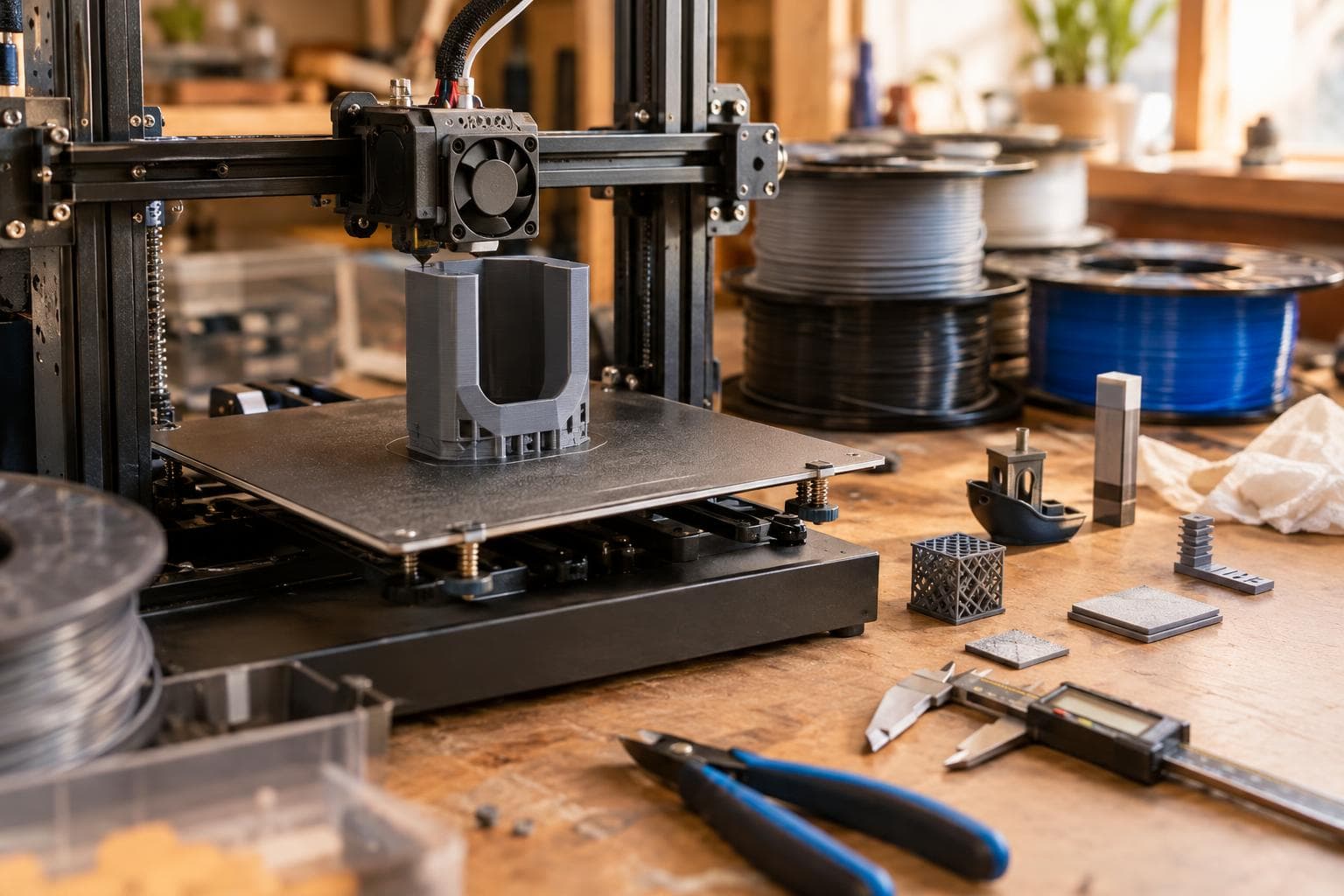
A PLA part that softens in a warm enclosure may survive the same temperature after annealing, but it will not remain the same size. Annealing PLA reorganizes the polymer structure, raising crystallinity and improving heat resistance while releasing internal stress and causing measurable shrinkage.
The useful question is not whether annealing works. It is whether the new temperature capability is worth giving up dimensional certainty for this particular part.
What annealing changes inside PLA
Most printed PLA starts in a mostly amorphous state. The polymer chains are tangled and frozen in place as each deposited road cools. Some PLA formulations crystallize more readily than others, but ordinary print cooling usually leaves the part with limited crystallinity.
During a heat treat 3D print process, the part is held above the temperature at which the chains can move, but below the material's melting range. The exact temperature depends on the filament formulation. Many PLA products are annealed somewhere around 80 to 110 °C, but that is a starting envelope, not a universal setting. The filament maker's guidance and a test coupon matter more than a generic number.
With enough heat and time, sections of the chains line up into ordered regions. These crystalline regions restrict chain movement and act somewhat like physical ties through the softer amorphous material around them. The result is a part that resists softening and deformation better under heat.
That improvement is not the same as raising every temperature limit by the same amount. A lightly loaded part may remain usable at a temperature that would deform a loaded bracket. Time under load, wall thickness, print orientation, infill, and the particular PLA grade all affect the result. PLA heat resistance should therefore be treated as a measured property of the finished part, not a guaranteed number attached to the word annealed.
Annealing also relaxes frozen-in stress from printing. That relaxation is one reason a part can move even if its external temperature seems moderate.
Why the part shrinks and distorts
There are two linked causes. First, the polymer chains pack more efficiently as ordered crystalline regions form. Second, the existing print stresses relax. Both alter the distance between material features.
Shrinkage is usually not equal in every direction. A printed part already has directional structure from its layers, line paths, cooling history, and infill. Heating can therefore make one axis move more than another. A long thin wall may bow, a hole may close, and a flat base may lift from a support surface. Internal voids and uneven wall thickness can create local temperature differences that make the distortion worse.
A part can also change while cooling. Cooling inside the oven reduces the thermal gradient and gives the material time to settle. Removing a hot part into room air, placing it on a cold bench, or clamping it tightly can lock in a new shape or create a curve as one face cools faster than the other.
Fibre-filled PLA behaves differently. The fibres restrain movement in the polymer matrix, so fibre-filled PLA generally distorts less during annealing than unfilled PLA. That does not mean it is dimensionally fixed. The matrix still shrinks, and the direction, amount, and type of fibre affect the result.
The practical consequence is direct: annealing is a material-treatment step, not a finishing step that leaves the CAD dimensions untouched.
Choose annealing by the part's job
We would anneal a part when its operating temperature or load makes ordinary PLA unreliable and when the design can tolerate measured dimensional change. We would not anneal a precision spacer, snap-fit enclosure, or threaded part merely because higher heat resistance sounds useful. If the part already works at its service temperature, annealing adds a failure mode without solving a real problem.
Use the as-printed part when:
- holes, bearing seats, press fits, or mating faces must stay close to their printed dimensions
- the part sees room-temperature service and no sustained load that could make it creep
- the shape is thin, asymmetric, or difficult to fixture during heating
- the design depends on flexible clips or living hinges
Use annealing when:
- the part will sit in a hot enclosure, vehicle interior, sun-heated cabinet, or near a warm motor
- stiffness under heat matters more than unchanged dimensions
- a replacement can be printed if the first test reveals too much movement
- the design can include machining or post-processing after the heat cycle
For a loaded component, test the actual geometry. A small material coupon can show whether the filament crystallizes, but it cannot predict how a tall hollow bracket will warp.
Practical annealing and design
Start with the filament manufacturer's temperature and time guidance. If none is available, use a small test part made with the same nozzle, layer height, wall count, infill, and print orientation as the real component. Do not treat a household oven display as an accurate chamber reading. Oven cycling and hot spots can be large compared with the dimensional tolerance you are trying to hold.
A workable procedure is:
- Print a coupon containing the critical features: holes, bosses, slots, thin walls, and a flat reference face.
- Measure those features before heating, including height, width, hole diameter, and any fit that matters.
- Place the coupon on a surface that supports it without forcing it flat. A flat plate can prevent a base from curling, but it can also restrain natural movement and transfer distortion elsewhere.
- Bring the part to the selected temperature gradually and hold it long enough for the whole section to heat through. Thick parts need more time than thin shells.
- Cool the part slowly in the switched-off oven unless the filament maker specifies another method.
- Measure it again after it has returned to room temperature. Test the fit and load condition, not only the outside dimensions.
The first test should answer two questions: how much did each axis change, and did the part stay useful under heat? Record both. If the dimensions move consistently, compensation can be built into the CAD model. If the movement varies from one location to another, changing the model scale will not solve the problem; the geometry, support, print orientation, or material may need to change.
Do not clamp a part aggressively to preserve a dimension unless you have tested the effect. A fixture can hold one feature while the rest of the part buckles around it. For a flat component, a lightly constrained fixture and a sacrificial perimeter often work better than hard pressure across the whole face.
Design the post-anneal condition, not the freshly printed condition. Add sacrificial material around critical faces if machining is possible. Leave clearance around holes and moving joints, then establish the final value from a test part. Avoid putting a thin wall beside a thick boss unless you have a reason for the uneven section; those regions heat and contract differently.
For an enclosure, print the lid and base in the same batch and anneal them together. Matching thermal history matters more than applying the same nominal oven setting on separate days. For a threaded part, test the actual screw or insert after annealing. A thread that turns freely before heating can tighten after a small hole reduction.
A fibre-filled grade can reduce movement, but its printed surface and layer behavior may differ from ordinary PLA. If a hole needs a close fit, plan for drilling, reaming, or another final sizing operation where the part and equipment allow it. That is often cheaper and more reliable than repeated attempts to predict a polymer's exact shrinkage from a data sheet.
The cheap way is good enough for many brackets: use ordinary PLA, keep it out of sustained heat, and avoid annealing. Annealing is worth the trouble when the temperature problem is real and the part can be validated afterward. It is not an automatic upgrade for every PLA print.
Compare the three common choices
| Property | As-printed PLA | Annealed unfilled PLA | Annealed fibre-filled PLA |
|---|---|---|---|
| Temperature capability | Lowest of these three under sustained load; depends on the PLA grade and print quality | Higher usable temperature than the same material before annealing because crystallinity and stress relief reduce softening | Usually higher usable temperature than its unannealed state, with the result depending on the fibre and matrix formulation |
| Dimensional tolerance | Best option when the printed dimensions already meet the job | Changes measurably during heating; shrinkage and warping must be measured | Usually changes less than unfilled PLA because the filler restrains movement, but it still changes |
| Strength behavior | Often adequate at room temperature, with anisotropy from layer bonding | Heat performance improves, but crystallization and shrinkage can alter fit and stress concentration | Stiffer and more movement-resistant in the fibre direction; layer bonding and matrix behavior still govern weak directions |
| Main failure mode | Creep or softening under heat and load | Distortion, loss of fit, or cracking from uneven restraint and thermal gradients | Directional warping, brittle behavior in some formulations, or residual matrix shrinkage |
Fibre-filled PLA is the better starting choice when lower annealing distortion matters and the part can accept its directional behavior. It is not a substitute for measurement, and it does not make a precision part immune to thermal movement.
Frequently asked questions
Does annealing PLA make it heatproof?
No. It raises crystallinity and usually improves resistance to softening and creep, but the final limit depends on the formulation, load, geometry, and duration. Test the finished part under its actual service conditions.
How much does PLA shrink during annealing?
There is no single reliable percentage for every PLA filament and geometry. Shrinkage depends on crystallization behavior, temperature, hold time, wall structure, print direction, and restraint. Measure a representative coupon in all relevant axes before and after the cycle.
Should fibre-filled PLA be annealed?
It can be, especially when lower distortion is useful. The fibres restrain movement, so fibre-filled PLA generally distorts less than unfilled PLA during annealing. The matrix still changes, and directional behavior remains, so validate the finished part rather than assuming the filler removes shrinkage.
The Boss Factory builds made-to-order work in 3D Printing & Prototyping.
Related services
All services →
Have a project in mind?
Tell us what you want built — we reply within 24–48 hours.