

- plywood grades
- cabinet plywood
- woodworking
- cnc routing
- material selection
Plywood Grades: Read the Stamp Before You Buy
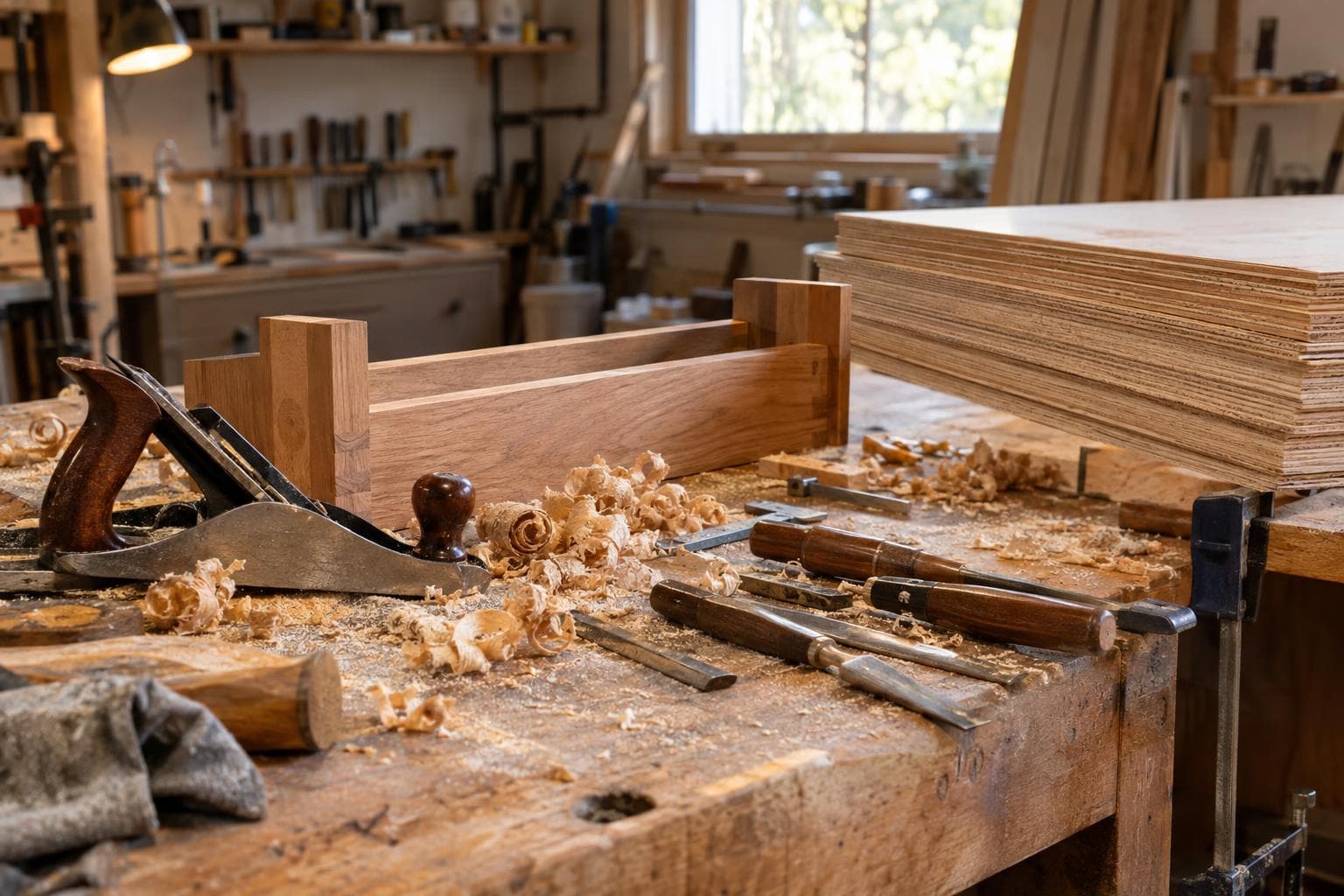
A plywood stamp can tell you whether the visible face is patched, whether the panel is rated for a particular exposure, and sometimes how it was built. It cannot, by itself, prove that the inner plies are sound. Read the face and back grades first, then inspect the core and intended use before paying for a panel that only looks like furniture stock.
What plywood face grades actually describe
Plywood face grades describe surface defects and repairs, not the quality of the core. The letter on each side usually refers to the appearance of that veneer: knots, splits, plugs, patches, open defects, and how much repair is allowed.
A common sequence runs from A through D, with A having the cleanest exposed face and D allowing more visible defects. The exact rules vary by standard and manufacturer, so the letter is not a universal promise. An A face from one grading system is not automatically identical to an A face from another.
The two letters matter separately. A panel marked A-B has a better front face than back face. A B-C panel may be sensible for a cabinet interior that has one visible side. A C-D panel may be acceptable behind a painted assembly or for temporary shop fixtures, but it is a poor starting point for a clear-finished tabletop.
A face grade can allow repairs. A filled knot or football-shaped veneer patch may be structurally acceptable while still showing through stain or clear finish. Repairs can also interrupt a routed edge, expose a different color, or create a small change in texture that paint does not hide unless the surface is prepared carefully.
Do not use the face letter as a shortcut for cabinet grade plywood. That phrase is used broadly in sales language and does not identify one universal construction standard. Ask what the stamp means, what standard it follows, and whether the core is suitable for the cuts and loads in your project.
Read both faces before choosing the panel
At the stack, check the panel rather than trusting only the label:
- Find the plywood stamp on the sheet edge or face and photograph it before the label is separated from the stack.
- Read the face and back grades in order. Decide which side will be exposed before choosing A-B over B-B or another combination.
- Hold the sheet at a low angle to reveal patches, loose veneer, sanding scars, and uneven thickness.
- Look at the edges for open gaps, dark voids, crushed plies, and plies that vary sharply in thickness.
- Check whether the stated thickness is nominal. A panel intended for a 3/4-inch opening may not measure exactly that thickness.
- Ask whether the panel is intended for interior dry use, humid service, or exterior exposure. Face appearance does not answer that question.
A clean face is worth paying for when it reduces filling, sanding, and visible defects in a clear finish. It is not worth paying for when the face will be hidden, fully painted, or covered by another material.
The core decides whether the panel behaves
The core is where a good-looking sheet can disappoint you. A panel can carry an excellent face grade and still have voids in the inner plies. Those voids may not matter for a shelf that is edge-banded and lightly loaded, but they can matter immediately when a router bit crosses the edge, a screw lands near a gap, or a narrow part is cut from the sheet.
Look for a stack of reasonably consistent plies with alternating grain directions. More plies do not automatically mean a better panel, but consistent cross-lamination usually gives a more predictable sheet than a core made from thick, irregular veneers and filler.
Core construction changes several practical results:
- Edge machining: Voids can turn a clean profile into a chipped edge or leave a hollow section under veneer.
- Screws: A screw entering a void has less wood around its threads. A nearby void can also let a face veneer split during fastening.
- Thin parts: Narrow rails, tabs, and brackets expose more of the core and have less material around each defect.
- Flatness: Uneven ply thickness and internal stress can produce a sheet that rocks on a flat bench or changes shape after cutting.
- Finish work: A porous edge absorbs glue, paint, or filler unevenly, making a finished edge look different from the face.
A void-free or tightly constructed multiply panel is useful when you will expose the edge, cut small parts, drill close to an edge, or rely on repeatable CNC routing. It is not automatically the right choice for every project. A strong panel with a rough face can create more finishing work than a less expensive panel with an acceptable face.
Face quality and core quality are separate decisions
Think of the panel as two specifications rather than one score. The face answers, “How much visible repair and surface defect can I accept?” The core answers, “How predictable must the panel be during cutting, fastening, and service?”
The combination you want depends on the finished part:
| Panel condition | Face and back concern | Core concern | Typical machining failure | Best fit |
|---|---|---|---|---|
| Construction sheathing | Visible patches, open defects, inconsistent sanding | Voids and uneven plies are common possibilities | Edge tear-out, hollow edges, variable screw grip | Hidden blocking, jigs, rough shop fixtures |
| Furniture panel with a sound face | One face may be clean while the reverse allows repairs | Core must be checked at edges and cut lines | Local chipping or weak fastener locations | Painted cabinets, panels with covered backs |
| Furniture panel with exposed edges | Both faces may look acceptable | Voids and ply gaps become visible after cutting | Broken edge strips, filler pockets, uneven profiles | Shelves, boxes, routed parts |
| Stable multiply panel | Face may still contain repairs unless specified otherwise | More consistent plies and fewer core gaps | Less core surprise, though tear-out is still possible | Small parts, exposed edges, repeated CNC work |
| Exterior-rated panel | Surface appearance varies by grade | Glue bond and exposure rating matter more than a clean face | Delamination or face checking if used outside its rating | Parts exposed to moisture when the stamp supports that use |
The table is a decision aid, not a substitute for the stamp or the manufacturer’s specification. “Furniture,” “marine,” and “cabinet” can describe intended use, appearance, or a sales category. They do not all guarantee the same core construction.
Spend in the order the job will punish
For a beginner, the sensible buying order is not “buy the cleanest face available.” Start with the failure that would ruin the part.
First: buy the right thickness and exposure rating
A beautiful sheet at the wrong thickness still produces the wrong joinery. Confirm the actual thickness against your dados, rabbets, edge banding, pocket hardware, or CNC toolpath. If moisture is part of the service condition, confirm the panel’s glue and exposure rating rather than judging it by the face.
For an indoor project in a controlled environment, an interior panel may be enough. For a damp room, an unheated structure, or an outdoor assembly, the bonding system and finish schedule become part of the material choice. No face grade can compensate for a panel used outside its rating.
Second: buy the core construction your cuts require
If the design exposes edges, contains narrow pieces, or needs holes near an edge, spend on a predictable core before spending on a cleaner face. A void-free edge can save more time than a flawless front veneer.
For broad panels with covered edges, the cheapest acceptable core may be enough. That is the upgrade that is not worth paying for up front when your design never exposes an edge and the fasteners are placed well away from likely gaps.
Third: buy the face grade needed by the finish
Choose the visible face based on the finish, not habit. Clear finish and translucent stain show repairs, color changes, and sanding differences. Opaque paint hides many face defects, though it does not hide a warped sheet or a weak core.
If one side is visible, a good face on that side and a less expensive back often makes more sense than paying for two matching faces. If the part will be seen from both sides, then the back grade becomes a real design requirement.
Inspect a panel before the machine does
A CNC or table saw will not make a questionable sheet more predictable. It will produce the same defect repeatedly and may spread a small core problem across every part.
Set a suspect panel on a genuinely flat surface and check for rocking, bows, twists, and edge curl. Sight down both long edges. Measure thickness at several locations with calipers if the fit is close. Mark defects on the sheet before nesting parts so the critical components do not land across them.
For a routed edge, make a small test cut in an offcut from the same panel. Test the actual cutter, feed rate, direction of cut, and depth. A face veneer can chip because of grain direction even when the core is excellent. Climb cutting may improve a local edge in some setups, but it also changes the workholding risk and is not a general cure.
For screw joints, drill test holes near the intended edge in scrap from the same sheet. If the bit breaks through into a void or the screw loses grip, move the joint, add a solid edging strip, or choose a different core. Do not assume a longer screw fixes missing wood.
For clear finishing, sand and finish a sample from the actual panel. Veneer color, patch visibility, glue absorption, and surface response are panel-specific. A sample from another sheet in the same nominal grade is not enough evidence.
Common stamp-reading mistakes
Treating A-B as a structural rating
A-B tells you about the two faces under a grading system. It does not certify that the core is void-free, that the glue suits exterior exposure, or that the sheet will stay flat in your environment.
Buying by the word “cabinet” alone
Cabinet grade plywood may be a useful category at a supplier, but it is not a complete technical specification. Read the face grades, core description, thickness tolerance, bonding rating, and intended service.
Assuming more letters mean more strength
The grade letters describe permitted appearance defects. Strength depends on veneer species, ply thickness, number and arrangement of plies, bonding, panel thickness, and defects in the core. A cleaner face does not add strength in proportion to its appearance.
Checking only the top sheet
The top sheet may be the cleanest or may have been selected for display. Inspect the actual panel you will cut, including its edge. If the stack is banded, ask for an exposed edge or a small offcut from the same batch.
Ignoring the reverse face
A poor back can show in an open shelf, reflect light through a thin panel, or split during a cut even when it never appears in the finished view. Decide where both faces go before nesting parts.
Frequently asked questions
Is cabinet grade plywood always void-free?
No. “Cabinet grade” is not one universal core standard. A panel sold under that description can have a clean face and still contain voids. Inspect the edge, ask how the core is constructed, and test an offcut if edge quality matters.
Which plywood grade is best for painted cabinets?
Choose a face that needs little filling and a core that supports your joinery. An expensive clear-face panel may add little value under opaque paint. A stable, reasonably smooth panel with an acceptable back is usually the better spend, provided its thickness and bonding rating suit the cabinet.
Can I use sheathing plywood for furniture?
You can use it for hidden parts, shop fixtures, or designs that accept open defects and rough edges. It is a poor default for clear-finished furniture, exposed edges, small CNC parts, and joints that depend on consistent screw grip. Check the actual sheet rather than assuming every construction panel is alike.
We build plywood work to order through custom woodworking and CNC & precision cutting.
Related services
All services →
Have a project in mind?
Tell us what you want built — we reply within 24–48 hours.